Advertisements
Advertisements
प्रश्न
Show that the given points form a parallelogram:
A(2.5, 3.5), B(10, – 4), C(2.5, – 2.5) and D(– 5, 5)
Advertisements
उत्तर
Let A(2.5, 3.5), B(10, – 4), C(2.5, – 2.5) and D(– 5, 5) are the vertices of a parallelogram.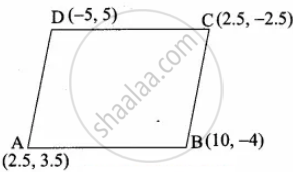
Slope of a line = `(y_2 - y_1)/(x_2 - x_1)`
Slope of AB = `(-4 - 3.5)/(10 - 2.5) = (-7.5)/(7.5)` = – 1
Slope of CD = `(5 + 2.5)/(-5 - 2.5) = (7.5)/(-7.5)` = – 1
Slope of AB = Slope of CD = – 1
∴ AB is Parallel to CD ...(1)
Slope of BC = `(-4 + 2.5)/(10 - 2.5) = (-1.5)/(7.5) = (-15)/75 = -1/5`
Slope of AD = `(5 - 3.5)/(-5 - 2.5) = 1.5/-7.5 = 15/(-75) = -1/5`
Slope of BC = Slope of AD
∴ BC is parallel to AD
From (1) and (2) we get ABCD is a parallelogram.
APPEARS IN
संबंधित प्रश्न
What is the inclination of a line whose slope is 1
What is the slope of a line perpendicular to the line joining A(5, 1) and P where P is the mid-point of the segment joining (4, 2) and (–6, 4).
Show that the given points are collinear: (– 3, – 4), (7, 2) and (12, 5)
If the three points (3, – 1), (a, 3) and (1, – 3) are collinear, find the value of a
The line through the points (– 2, 6) and (4, 8) is perpendicular to the line through the points (8, 12) and (x, 24). Find the value of x.
Show that the given points form a right angled triangle and check whether they satisfy Pythagoras theorem
A(1, – 4), B(2, – 3) and C(4, – 7)
If the points A(2, 2), B(– 2, – 3), C(1, – 3) and D(x, y) form a parallelogram then find the value of x and y.
A quadrilateral has vertices at A(– 4, – 2), B(5, – 1), C(6, 5) and D(– 7, 6). Show that the mid-points of its sides form a parallelogram.
The slope of the line joining (12, 3), (4, a) is `1/8`. The value of ‘a’ is
Without using distance formula, show that the points (−2, −1), (4, 0), (3, 3) and (−3, 2) are vertices of a parallelogram
