Advertisements
Advertisements
प्रश्न
Show that the following points are the vertices of a square:
(i) A (3,2), B(0,5), C(-3,2) and D(0,-1)
Advertisements
उत्तर
The given points are A (3,2), B(0,5), C(-3,2) and D(0,-1).
`AB = sqrt((0-3)^2 +(5-2)^2 ) = sqrt((-3)^2 +(3)^2 ) = sqrt(9+9) = sqrt(18) = 3 sqrt(2) units `
`BC= sqrt((-3-0)^2 + (2-5)^2) = sqrt((-3)^2 +(3)^2) = sqrt(9+9) = sqrt(18) = 3 sqrt(2) ` units
`CD = sqrt((0+3)^2 + (-1-2)^2) = sqrt((3)^2 +(-3)^2) = sqrt(9+9) = sqrt(18) = 3 sqrt(2) units`
`DA = sqrt((0-3)^2 +(-1-2)^2) = sqrt((-3)^2+(-3)^2) = sqrt(9+9) =sqrt(18) = 3sqrt(2) units`
Therefore`AB =BC=CD=DA=3 sqrt(2) units`
Also, `AC = sqrt((-3-3)^2 +(2-2)^2) = sqrt((-6)^2 +(0)^2) = sqrt(36) = 6 units`
`BD = sqrt((0-0)^2 + (-1-5)^2) = sqrt((0)^2 +(-6)^2 )= sqrt(36) = 6 units`
Thus, diagonal AC = diagonal BD
Therefore, the given points from a square.
APPEARS IN
संबंधित प्रश्न
On which axis do the following points lie?
Q(0, -2)
Show that the points (−3, 2), (−5,−5), (2, −3) and (4, 4) are the vertices of a rhombus. Find the area of this rhombus.
In the seating arrangement of desks in a classroom three students Rohini, Sandhya and Bina are seated at A(3, 1), B(6, 4), and C(8, 6). Do you think they are seated in a line?
Show that the following points are the vertices of a rectangle.
A (2, -2), B(14,10), C(11,13) and D(-1,1)
Find the co-ordinates of the point which divides the join of A(-5, 11) and B(4,-7) in the ratio 7 : 2
Points P, Q, R and S divide the line segment joining the points A(1,2) and B(6,7) in five equal parts. Find the coordinates of the points P,Q and R
Find the area of quadrilateral PQRS whose vertices are P(-5, -3), Q(-4,-6),R(2, -3) and S(1,2).
If the points A(1, –2), B(2, 3) C(a, 2) and D(– 4, –3) form a parallelogram, find the value of a and height of the parallelogram taking AB as base.
If \[D\left( - \frac{1}{5}, \frac{5}{2} \right), E(7, 3) \text{ and } F\left( \frac{7}{2}, \frac{7}{2} \right)\] are the mid-points of sides of \[∆ ABC\] , find the area of \[∆ ABC\] .
If the distance between points (x, 0) and (0, 3) is 5, what are the values of x?
What is the area of the triangle formed by the points O (0, 0), A (6, 0) and B (0, 4)?
Write the coordinates of a point on X-axis which is equidistant from the points (−3, 4) and (2, 5).
If P (x, 6) is the mid-point of the line segment joining A (6, 5) and B (4, y), find y.
If the centroid of the triangle formed by the points (a, b), (b, c) and (c, a) is at the origin, then a3 + b3 + c3 =
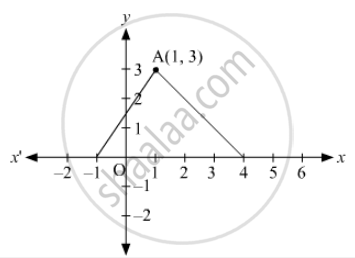
In Fig. 14.46, the area of ΔABC (in square units) is
A line intersects the y-axis and x-axis at P and Q , respectively. If (2,-5) is the mid-point of PQ, then the coordinates of P and Q are, respectively
Write the X-coordinate and Y-coordinate of point P(–5, 4).
A point both of whose coordinates are negative will lie in ______.
If the perpendicular distance of a point P from the x-axis is 5 units and the foot of the perpendicular lies on the negative direction of x-axis, then the point P has ______.
(–1, 7) is a point in the II quadrant.
