Advertisements
Advertisements
प्रश्न
Select the correct answer from the options given below.
Is the group number of the element whose atomic number is 4.
पर्याय
group – 1
group – 2
group – 18
Advertisements
उत्तर
group – 2
APPEARS IN
संबंधित प्रश्न
How do the atomic size and metallic character of elements vary as we move?
- down a group and
- from left to right in a period
Use the letters only written in the Periodic Table given below to answer the questions that Follow:
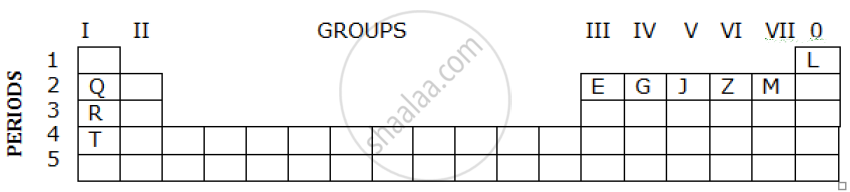
- State the number of valence electrons in atom J.
- Which element shown forms ions with a single negative charge?
- Which metallic element is more reactive than R?
- Which element has its electrons arranged in four shells?
In the following set of elements, one element does not belong to the set. Select this element and state why it does not belong:
Oxygen, Nitrogen, Carbon, Chlorine, Fluorine
How does the tendency to gain electrons change as we go down in group 17 of the periodic table? Why does it change this way?
An element has 2 electrons in its N shell.
State the name assigned to this group.
An element 'M' has atomic number 12.
(a) Write its electronic configuration.
(b) State the group to which 'M' belongs.
(c) Is 'M' a metal or a non-metal.
(d) Write the formula of its chloride.
Fill in the blank
There are ______ groups and ______ periods in the modern form of periodic table.
Select the correct answer
Number of shells in potassium are
An element Z has atomic number 16. Answer the following
(a) State the period and group to which Z belongs
(b) Is Z a metal or a non-metal?
(c) State the formula between Z and hydrogen.
(d) what kind of a compund is this?
Name and state the following with reference to the elements of the first three periods of the periodic table.
Non-metallic elements present in Period 3 of Groups 15 and 16.
