Advertisements
Advertisements
प्रश्न
Read the following extract and do the given activities:
A1. Match the describing words from the Cloud ‘A’ with Cloud ‘B’: (02)
| Cloud ‘A’ | Cloud ‘B’ | ||
| 1. | broad | a. | noise |
| 2. | humorous | b. | jest |
| 3. | chuckling | c. | way |
| 4. | trifling | d. | grin |
| “There to the printer,” I exclaimed, And, in my humorous way, I added (as a trifling jest,) “There’ll be the devil to pay. He took the paper, and I watched, And saw him peep within At the first line, he read, his face Was all upon the grin He read the next; the grin grew broad. And shot from ear to ear; He read the third; a chuckling noise I now began to hear. The fourth; he broke into a roar; The fifth; his waistband split; The sixth; he burst five buttons off And tumbled in a fit. |
A2. Pick out two lines from the extract that indicate humour. (02)
A3. Write two pairs of rhyming words from the extract. (01)
Advertisements
उत्तर
A1.
| Cloud ‘A’ | Answers | |
| 1. | board | grin |
| 2. | humorous | way |
| 3. | chucking | noise |
| 4. | trifling | jest |
A2. Lines that indicate humour are:
- The fifth; his waistband split;
- The sixth; he burst five buttons off
- And tumbled in a fit.
A3. Rhyming Words:
- within - grin
- ear – hear
- spilt - fit
APPEARS IN
संबंधित प्रश्न
Read the following extract and answer the questions given below
What makes a nation's pillars high
And its foundations strong?
What makes it mighty to defy
The foes that round it throng?
It is not gold. Its kingdoms grand
Go down in battle shock;
Its shafts are laid on sinking sand,
Not on abiding rock.
(1) Why are the wealthy kingdoms unstable'? (1)
(2) Do you feel wars are the only solution to the problems between nations'? Explain. (1)
(3) Give the rhyming scheme used in the extract. (1)
(4) Pick out the words/expressions related to the mighty kingdom. (1)
Read the following extract and answer the questions given below :
We, heroes and poor devils;
the feeble, the braggarts; the unfinished,
and capable of everything impossible
as long as it's not seen or heard
Don Juans, women and men, who come and go
with the fleeting passage of a runner
or of a shy hotel for travellers.
And we with our small vanities,
our controlled hunger for climbing
and getting as far as everybody else has gotten
because it seems that is the way of the world.
(1) Who are heroes and what are they capable of? (1)
(2) According to you, what difficulties do the middle-class people face? (1)
(3) Name and explain the figure of speech in the following line :
... Women and men, who come and go. (1)
(4) Pick out the line from the extract, which shows the overambitious nature of the middle-class people. (1)
Read the following extract and answer the questions given below:
I ran into a stranger as he passed by
"Oh, excuse me please'' was my reply.
He said, ''Please excuse me too; wasn't even watching ·for you.''
We were very polite, this stranger and I.
We went on our way and we said good-bye.
But at home, a different story is told,
How we treat our loved ones, young and old.
Later that day, cooking the evening meal,
My daughter stood beside me very still.
When I turned, I nearly knocked her down.
''Move out of the way," I said with a frown.
She walked away, her little heartbroken.
I didn't realize how harshly I'd spoken.
(1) How does the poetess greet the stranger?
(2) Describe an incident when your mother was harsh at you.
(3) Write down the rhyme scheme of the first stanza.
(4) Pick out the line from the extract which shows the mother's anger.
Read the following extract and answer the questions given below: (4)
Read the extract and do the activities that follow: (4)
| Tom | : | (down L.). I believe the place is haunted |
| George | : | Nonsense. No one believes in haunted houses nowadays. There's someting gueer about the place, I'II admit, but can't be haunted. (Scream off R.) |
| Ginger | : | Listen! What was that ? (Scream repeated. This time much louder.) |
| Alfie | : | I want to go home ! |
| Tom | : | It sounds as though someone's being murdered. (Grappling with the door). I'm going to force this door. |
| Ginger | : | (Crossing L.) It's going to be a tough job, Tom |
| Alfie | : | (more lustily). I want to go home |
| George | : | (up C.) Shut up Alfie, you'II rose the house. Listen! There's someone coming _____ and it's someone in white |
| Ginger | : | It's a ghost |
| Alfie | : | (rushing to the door L.) I'm going home! |
| George | : | (coming down L.) Let me give you a hand with this door. |
| Tom | : | Buck up! |
| Ginger | : | Put your shoulder against it. (Enter the Ghost R. In the dim light his figure has a distinctly uncanny appearance). |
| Ghost | : | What on earth's the meaning of this commotion? (IIe switches on the light and is seen to be a dentist, wearing a white surgical coat. The “grinning mouths'' are seen to be models made of plaster of Paris. The boys stare about them in amazement) |
| Dentist | : | (sternly). Who are you, and what are you doing in my house? |
| Tom | : | I say – I'm awfully sorry – but we thought you were a ghost. |
| Dentist | : | (bewildered). A ghost! Why on earth should you think I was a ghost? |
| George | : | (crossing C.) I'm awfully sorry, sir. You see, we were out carol-singing, and____ |
| Dentist | : | Oh, so it was you who who were making that horrible din outside? |
| George | : | Yes – that was Ginger's idea ____ |
B1. Complete _____
Complete the following sentences:
(i) The boys considered the dentist as a ghost , because ________
(ii) Listening to the repeated scream, Tom thought that ________
(iii) The grinning mouths were models made of ________
(iv) The idea of carol-singing was given by _______
B2. Convert dialogue into a story:
Convert the above dialoguc into a story in about 50 words.
Read the following extract and answer the questions given below:
Now there is only one type of bobcat we see
The one that is for free, clearing the pavements of all debris
We used to walk through a footpath in a forest of pine
The smell intoxicating our lungs and mind
Now the only smell to be found comes from plastic trees
Swaying on my rear-view mirror, labelled pine breeze
We used to watch the valley play hide and seek
Questions:
(1) What signs of urbanisation are mentioned in the first six lines of the extract?
(2) Do you think skyscrapers are necessary? Why do you think so?
(3) Pick out the example of personification from the extract.
(4) Pick out the lines from the extract expressing the fond memory of the poet about the pines.
Read the extract and do all the activities that follow:
We used to think seven generations ahead
Now we have become selfish
Only thinking about me, myself and I
Only thinking in the present, not learning from the past.
We used to stroll barefoot through the overgrown grass,
Its morning dew tickling our feet
Now we step outside onto the rugged concrete
No more natural than the over-processed food we eat
We used to walk down the snow sprinkled trail,
Maybe catch a glimpse of a bobcat, playing eye tricks with its tail
Now there is only one type of bobcat we see
The one that is fur-free, clearing the pavement of all debris
We used to walk through a footpath in a forest of pine
The smell intoxicating our lungs and mind
Now the only smell to be found comes from plastic trees.
Swaying on my rearview mirror, labelled pine breeze
we used to watch the valley play hide and seek
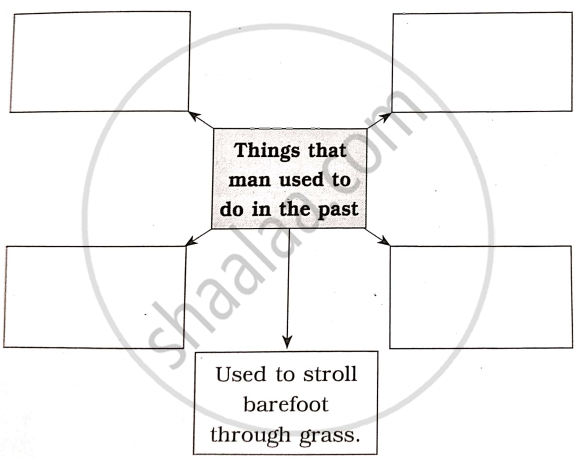
A1. Web :
Complete the web with the things man used to do in the past:
A2. Poetic Devices :
'We used to walk down the snow sprinkled trail'
Name the figure of speech in the above line and find out another example of the same from the extract.
A3. Personal Response :
Write in brief your views about past and present lifestyle.
A4. Poetic Creativity :
'Now we step outside onto the rugged concrete No more natural than the over-processed food.'
Read the above lines and compose at least two lines of your own. based on the same theme.
Read the extract given below and answer the questions that follow:
|
I stand and look at them long and long. They do not sweat and whine about their condition. |
- The poet who has written these lines is ______.
- Robert Frost
- Carolyn Wells
- Walt Whitman
- Ogden Nash
- Who are ‘they’ referred to here?
- Animals
- Tigers
- Ananda’s friends
- Wanda’s dresses
- The poet looks at them long and long because he ______.
- Which word in the extract means ‘complain’?
Based on the careful reading of the passage given below, answer any four out of five questions that follow:
|
1. When you see me sitting quietly, 2. When my bones are stiff and aching, 3. I’m the same person I was back then, - Maya Angelou |
- What does the poet think she looks like, when sitting quietly?
- Does the poet invite pity? Quote a line to support your argument.
- What has changed in the poet over the course of years?
- Pick out a word from the second stanza which means ‘faltering’.
- Why does the poet consider herself lucky?
