Advertisements
Advertisements
प्रश्न
Prove that the sum of the squares of the diagonals of a parallelogram is equal to the sum of the squares of its sides.
Advertisements
उत्तर
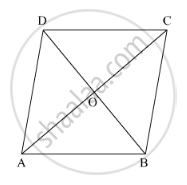
Diagonals of a parallelogram bisect each other, i.e., O is the midpoint of AC and BD.
In ∆ABD, point O is the midpoint of side BD.
BO = OD = `1/2`BD
∴ by Apollonius theorem,
AB2 + AD2 = 2AO2 + 2BO2 ...(1)
In ∆CBD, point O is the midpoint of side BD.
BO = OD = `1/2`BD
∴ by Apollonius theorem,
CB2 + CD2 = 2CO2 + 2BO2 ...(2)
Adding (1) and (2), we get,
AB2 + AD2 + CB2 + CD2 = 2AO2 + 2BO2 + 2CO2 + 2BO2
⇒ AB2 + AD2 + CB2 + CD2 = 2AO2 + 4BO2 + 2AO2 ...(∵ OC = OA)
⇒ AB2 + AD2 + CB2 + CD2 = 4AO2 + 4BO2
⇒ AB2 + AD2 + CB2 + CD2 = (2AO)2 + (2BO)2
⇒ AB2 + AD2 + CB2 + CD2 = (AC)2 + (BD)2
⇒ AB2 + AD2 + CB2 + CD2 = AC2 + BD2
∴ the sum of the squares of the diagonals of a parallelogram is equal to the sum of the squares of its sides.
APPEARS IN
संबंधित प्रश्न
In the given figure, seg PS is the median of ∆PQR and PT ⊥ QR. Prove that,
PR2 = PS2 + QR × ST + `("QR"/2)^2`

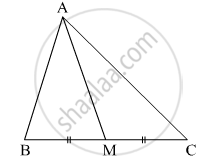
In ∆ABC, point M is the midpoint of side BC. If, AB2 + AC2 = 290 cm2, AM = 8 cm, find BC.
Some question and their alternative answer are given. Select the correct alternative.
Altitude on the hypotenuse of a right angled triangle divides it in two parts of lengths 4 cm and 9 cm. Find the length of the altitude.
A side of an isosceles right angled triangle is x. Find its hypotenuse.
In ∆ABC, seg AP is a median. If BC = 18, AB2 + AC2 = 260, Find AP.
Sum of the squares of adjacent sides of a parallelogram is 130 sq.cm and length of one of its diagonals is 14 cm. Find the length of the other diagonal.
Seg PM is a median of ∆PQR. If PQ = 40, PR = 42 and PM = 29, find QR.
Seg AM is a median of ∆ABC. If AB = 22, AC = 34, BC = 24, find AM
Choose the correct alternative:
Out of the following which is a Pythagorean triplet?
In ΔABC, seg AP is a median. If BC = 18, AB2 + AC2 = 260, then find the length of AP.
Out of given triplets, which is not a Pythagoras triplet?
Out of given triplets, which is not a Pythagoras triplet?
Which of the following figure is formed by joining the mid-points of the adjacent sides of a square?
In the given figure, triangle ABC is a right-angled at B. D is the mid-point of side BC. Prove that AC2 = 4AD2 – 3AB2.

