Advertisements
Advertisements
प्रश्न
Prove that the curves y2 = 4x and x2 = 4y divide the area of square bounded by x = 0, x = 4, y = 4 and y = 0 into three equal parts.
Advertisements
उत्तर
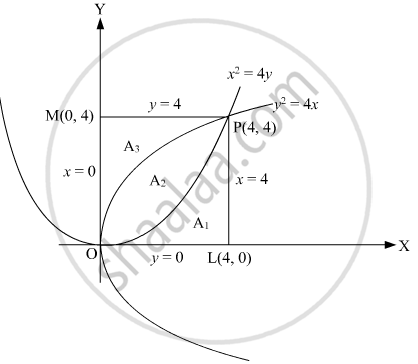
A(OABC) = 4 × 4 = 16 sq. units
From, y2 = 4x and x2 = 4y
`(x^2/4)^2 = 4x`
or `x^4/16 = 4x`
or x4 - 64x = 0
or x(x3 - 64) = 0
or x = 0 or x = 4
when x = 0, y = 0
x = 4, y = 4
Point of intersection of the two parabolas is (0, 0) and (4, 4).
Area of part III = `int_0^4 y dx` (parabola x2 = 4y)
= `int_0^4 (x^2)/4 dx = [1/4 x^3/3]_0^4`
= `1/12(64 - 0)`
= `64/12`
= `16/3` sq.units
Area of I = Area of square - Area of II and III
= `16 - int_0^4 sqrt(4x) dx`
= `16 - (2 × 2)/3 [x^(3/2)]_0^4`
= `16 - 32/3` sq. units
= `16/3` sq. units
Area of II = Area of square - Area of I - Area of III
= 16 - `16/3 - 16/3` sq. units
= `16/3` sq. units
The two curves divide the square into three equal parts.
संबंधित प्रश्न
Using integration, find the area of the region bounded between the line x = 2 and the parabola y2 = 8x.
Find the area under the curve y = \[\sqrt{6x + 4}\] above x-axis from x = 0 to x = 2. Draw a sketch of curve also.
Find the area of the region bounded by x2 = 4ay and its latusrectum.
Find the area bounded by the curve y = 4 − x2 and the lines y = 0, y = 3.
Draw a rough sketch and find the area of the region bounded by the two parabolas y2 = 4x and x2 = 4y by using methods of integration.
Using integration, find the area of the region bounded by the triangle whose vertices are (−1, 2), (1, 5) and (3, 4).
Find the area of the region bounded by \[y = \sqrt{x}\] and y = x.
Find the area bounded by the parabola y = 2 − x2 and the straight line y + x = 0.
Using integration find the area of the region:
\[\left\{ \left( x, y \right) : \left| x - 1 \right| \leq y \leq \sqrt{5 - x^2} \right\}\]
Using integration, find the area of the following region: \[\left\{ \left( x, y \right) : \frac{x^2}{9} + \frac{y^2}{4} \leq 1 \leq \frac{x}{3} + \frac{y}{2} \right\}\]
Find the area enclosed by the curves y = | x − 1 | and y = −| x − 1 | + 1.
Find the area enclosed by the parabolas y = 4x − x2 and y = x2 − x.
Find the area bounded by the parabola x = 8 + 2y − y2; the y-axis and the lines y = −1 and y = 3.
Find the area bounded by the parabola y2 = 4x and the line y = 2x − 4 By using horizontal strips.
The area of the region formed by x2 + y2 − 6x − 4y + 12 ≤ 0, y ≤ x and x ≤ 5/2 is ______ .
The area of the region (in square units) bounded by the curve x2 = 4y, line x = 2 and x-axis is
Find the equation of the parabola with latus-rectum joining points (4, 6) and (4, -2).
Find the area of the region bounded by the parabola y2 = 2x and the straight line x – y = 4.
Find the area of the region bounded by the parabola y2 = 2px, x2 = 2py
Using integration, find the area of the region bounded by the line 2y = 5x + 7, x- axis and the lines x = 2 and x = 8.
Find the area enclosed by the curve y = –x2 and the straight lilne x + y + 2 = 0
Find the area bounded by the curve y = `sqrt(x)`, x = 2y + 3 in the first quadrant and x-axis.
The area of the region bounded by the curve y = x + 1 and the lines x = 2 and x = 3 is ______.
Using integration, find the area of the region `{(x, y): 0 ≤ y ≤ sqrt(3)x, x^2 + y^2 ≤ 4}`
Area lying in the first quadrant and bounded by the circle `x^2 + y^2 = 4` and the lines `x + 0` and `x = 2`.
The area bounded by the curve `y = x^3`, the `x`-axis and ordinates `x` = – 2 and `x` = 1
Let f(x) be a non-negative continuous function such that the area bounded by the curve y = f(x), x-axis and the ordinates x = `π/4` and x = `β > π/4` is `(βsinβ + π/4 cos β + sqrt(2)β)`. Then `f(π/2)` is ______.
Find the area of the region bounded by the curve x2 = 4y and the line x = 4y – 2.
