Advertisements
Advertisements
प्रश्न
p-block is composed of groups 1 and 2.
पर्याय
Right
Wrong
Advertisements
उत्तर
p-block is composed of groups 1 and 2- Wrong
संबंधित प्रश्न
In the Modern Periodic Table, which are the metals among the first ten elements?
Name the scientist who first of all showed that atomic number of an element is a more fundamental property than its atomic mass.
Fill in the following blank with suitable word:
Group 17 elements are known as ...............
What is meant by a period, in a periodic table?
What is the significance of atomic number in the modern classification of elements? Explain with the help of an example.
How were the positions of cobalt and nickel resolved in the modern periodic table?
Which of the following statement is correct in regard to the classification of elements?
(a) Elements in modern periodic table are arranged on the basis of increasing atomic masses.
(b) Elements in Mendeleev's periodic table are arranged on the basis of increasing atomic numbers.
(c) In modern periodic table, the element nickel of lower atomic mass is kept before the element cobalt of higher atomic mass.
(d) In modern periodic table, the isotopes of chlorine having different atomic masses are kept in the same group.
Which element has two shells, both of which are completely filled with electrons?
How would the tendency to lose electrons change as we go from left to right across a period of the periodic table?
What is the number of elements is 1st period the modern periodic table?
The following diagram shows a part of the periodic table in which the elements are arranged according to their atomic numbers. (The letters given here not the chemical symbols of the elements):
| a 3 |
b 4 |
c 5 |
d 6 |
e 7 |
f 8 |
g 9 |
h 10 |
|
| i 11 |
j 12 |
k 13 |
l 14 |
m 15 |
n 16 |
o 17 |
p 18 |
(i) Which element has a bigger atom, a or f?
(ii) Which element has a higher valency, k or o?
(iii) Which element is more metallic i or k?
(iv) Which element is more non-metallic, d or g?
(v) Select a latter which represents a metal of valency 2.
(vi) Select a letter which represents a non-metal of valency 2.
Correct the statement.
Transition elements are placed at extreme right of the periodic table.
Name two elements in Alkali metals.
Name the type of elements which have outermost shell complete.
Name the type of elements which have two electrons in the outermost orbit.
An element barium has the atomic number 56. Look up its position in the periodic table and answer the following question.
Is it larger or smaller than caesium (Cs)?
State the modern periodic law for the classification of elements. How many (i) groups and (ii) periods are there in the modern periodic table?
An element A has 2 electrons in its fourth shell. State its electronic configuration.
Give the symbol and valency of the following element and radical.
Magnesium
Give the symbol and valency of the following element and radical.
Sulphite
Give the chemical formula of carbonic acid
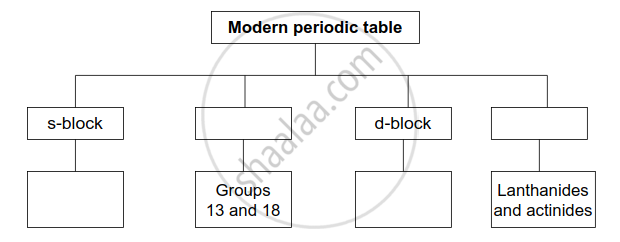
Complete the following flow chart.
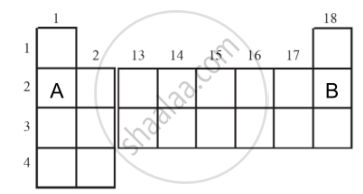
In the modern periodic table, the positions of 1 to 20 elements are shown here. Identify the elements A and B. Write their atomic number.
Distinguish between:
s-block - p-block
Element ‘X’ forms a chloride with the formula XCl2, which is solid with a high melting point. X would most likely be in the same group of the periodic table as: ______
The inert gas which lies in the third period is ______
Which of the following statements about the Modern Periodic Table is correct:
The three elements A, B and C with similar properties have atomic masses X, Y and Z respectively. The mass of Y is approximately equal to the average mass of X and Z. What is such an arrangement of elements called as? Give one example of such a set of elements.
Three elements A, B and C have 3, 4 and 2 electrons respectively in their outermost shell. Give the group number to which they belong in the Modern Periodic Table. Also, give their valencies.
Compare the radii of two species X and Y. Give reasons for your answer.
- X has 12 protons and 12 electrons
- Y has 12 protons and 10 electrons
Choose an element from period 3 of modern periodic table that matches the description given below in instance. Give a reason for your choice.
It has same valency as Lithium.
A part of modern periodic table is given below. On its basis, answer the following questions:
| Group No. → | 1 | 2 | 13 | 14 | 15 | 16 | 17 | 18 |
| Period ↓ | ||||||||
| 2 | A | B | ||||||
| 3 | E | D | F | C |
Which of the element is a Noble gas?
A part of modern periodic table is given below. On its basis, answer the following questions:
| Group No. → | 1 | 2 | 13 | 14 | 15 | 16 | 17 | 18 |
| Period ↓ | ||||||||
| 2 | A | B | ||||||
| 3 | E | D | F | C |
Which of the element is a Metalloid?
Define periods of modern periodic table.
Answer the following in respect of element \[\ce{_16^32S}\].
To which group and period does it belong?
