Advertisements
Advertisements
प्रश्न
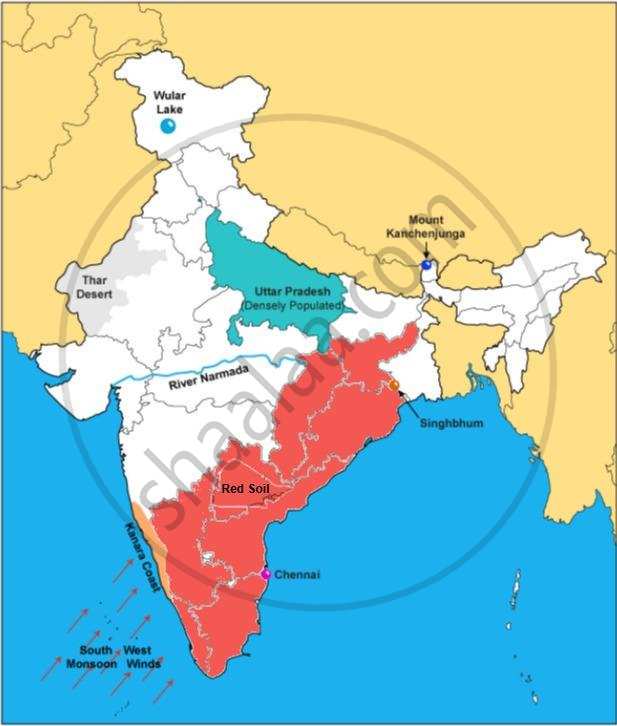
On the outline map of India provided:
- Shade and label Thar Desert.
- Label the river Narmada.
- Shade and name the Wular Lake.
- Shade and label Kanara coast.
- Mark and name Mount Kanchenjunga.
- Shade and label a densely-populated region in India.
- Shade and label a region with Red soil in India.
- Mark with a dot and name Chennai.
- Mark and label the Arabian Sea branch of S.W. Monsoon.
- Mark with a dot and name Singhbhum.
Advertisements
उत्तर
APPEARS IN
संबंधित प्रश्न
On the outline map of India provided:
a) Mark and name the Nilgiris.
b) Shade and label the Malwa Plateau.
c) Shade and label the Malabar Coastal Plains.
d) Mark and name the River Gomati.
e) Mark and name the Andaman Sea.
f) Mark and name Allahabad.
g) Mark with a single arrow and name the winds that bring winter rains to North West India.
h) Mark and name Digboi.
i) Mark an area with laterite soil below the Tropic of Cancer.
j) Mark and name the Karakoram Pass.
What is the value of the contour line in square 0226? What is the contour interval in the map?
Name one region shown on the map which is unsuitable for the cultivation of crops.
On the outline map of India provided:
(a) Shade and label the Gangetic Plain. [1]
(b) Shade and label an area of laterite soil in North India. [1]
(c) Mark and label the Karakoram Mountains. [1]
(d) Mark and name the Palk Strait. [1]
(e) Shade and label the river Cauveri. [1]
(f) Mark and name Mumbai. [1]
(g) Mark and name the Nathu La Pass. [1]
(h) Mark and name Digboi. [1]
(i) Shade and name the Deccan Plateau. [1]
(j) Shade and label the river Jhelum. [1]
Why is the Pamir Knot known as ‘the roof of the world’.
On the outline map of India provided:
(a) Mark and name Chennai
(b) Label the river Godavari
(c) Shade and label the Chhota Nagpur Plateau
(d) Shade and name the Gulf of Kachchh
(e) Mark and name the Indo-Gangetic Plains
(f) Shade and label an area with Red Soil
(g) Mark and name the winds which bring rain to Mumbai in July and August
(h) Mark and name the Satpura Range
(i) Mark and name the Jharia Coal Field
(j) Shade and label the Northern Circar coastal region
On the outline map provided:
(a) Shade and label the country Nepal.
(b) Shade and label an area of black soil in India.
(c) Mark and label the Konkan Coast.
(d) Shade and label one region of winter rainfall in India.
(e) Sade and label the Sulaiman Ranges.
(f) Label the River Yamuna.
(g) Label the River Tapti.
(h) Shade and label the Vindhya Ranges.
Show the following on the outline map provided:
(a) Shade and label the Satpura Range.
(b) Label the River Krishna.
(c) Label the River Ravi.
(d) Shade and label the Khasi Hills.
(e) Mark with arrows the direction of the North-East Monsoon winds over the Bay of Bengal.
(f) Mark and label the Malabar coast.
(g) Shade and label an area of Laterite soil in India.
(h) Shade and label an area of Limestone in India.
Name the physical divisions into which India can be divided.
On the outline map of India provided:
- Mark and label the river Krishna. [1]
- Mark and label the Eastern Ghats. [1]
- Shade and label a densely populated area in the southern part of India. [1]
- Shade and label the Konkan coastal plain. [1]
- Mark with an arrow and label the direction of western disturbance. [1]
- Shade and label the Thar Desert. [1]
- Shade and label the Andaman Sea. [1]
- Mark and label the city Chennai. [1]
- Mark and name the highest peak of Himalayas in India. [1]
- Mark and label Mumbai High. [1]
