Advertisements
Advertisements
प्रश्न
On dividing `3x^3 + x^2 + 2x + 5` is divided by a polynomial g(x), the quotient and remainder are (3x – 5) and (9x + 10) respectively. Find g(x).
Advertisements
उत्तर
By using division rule, we have
Dividend = Quotient × Divisor + Remainder
∴` 3x^3 + x^2 + 2x + 5 = (3x – 5)g(x) + 9x + 10`
⇒`3x^3 + x^2 + 2x + 5 – 9x – 10 = (3x – 5)g(x)`
⇒`3x^3 + x^2 – 7x – 5 = (3x – 5)g(x)`
⇒ `(g(x)=3x^3+x^2-7x-5)/(3x-5)`
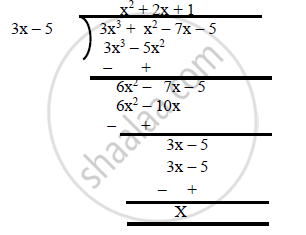
`∴g(x) = x^2 + 2x + 1`
APPEARS IN
संबंधित प्रश्न
Find the zeros of the quadratic polynomial 6x2 - 13x + 6 and verify the relation between the zero and its coefficients.
Find the zeros of the quadratic polynomial 4x2 - 9 and verify the relation between the zeros and its coffiecents.
If two zeroes of the polynomial x4 – 6x3 – 26x2 + 138x – 35 are 2 ± `sqrt3` , find other zeroes
If α and β are the zeroes of the quadratic polynomial f(x) = ax2 + bx + c, then evaluate `1/(aalpha+b)+1/(abeta+b)`.
Find the condition that the zeros of the polynomial f(x) = x3 + 3px2 + 3qx + r may be in A.P.
Find the zeroes of the quadratic polynomial` (x^2 ˗ 5)` and verify the relation between the zeroes and the coefficients.
Find the quadratic polynomial whose zeroes are `2/3` and `-1/4` Verify the relation between the coefficients and the zeroes of the polynomial.
Find the quadratic polynomial, sum of whose zeroes is 0 and their product is -1. Hence, find the zeroes of the polynomial.
Find the quadratic polynomial, sum of whose zeroes is `( 5/2 )` and their product is 1. Hence, find the zeroes of the polynomial.
Find a cubic polynomial whose zeroes are `1/2, 1 and -3.`
If f(x) =` x^4 – 3x^2 + 4x + 5` is divided by g(x)= `x^2 – x + 1`
If 𝛼, 𝛽 are the zeroes of the polynomial f(x) = x2 + x – 2, then `(∝/β-∝/β)`
If α, β are the zeros of the polynomial f(x) = ax2 + bx + c, then\[\frac{1}{\alpha^2} + \frac{1}{\beta^2} =\]
A quadratic polynomial, whose zeroes are –3 and 4, is ______.
Find the zeroes of the following polynomials by factorisation method and verify the relations between the zeroes and the coefficients of the polynomials:
3x2 + 4x – 4
Find the zeroes of the following polynomials by factorisation method and verify the relations between the zeroes and the coefficients of the polynomials:
`4x^2 + 5sqrt(2)x - 3`
Given that `sqrt(2)` is a zero of the cubic polynomial `6x^3 + sqrt(2)x^2 - 10x - 4sqrt(2)`, find its other two zeroes.
Find the zeroes of the following polynomials by factorisation method and verify the relations between the zeroes and the coefficients of the polynomials:
`7y^2 - 11/3 y - 2/3`
Find the zeroes of the quadratic polynomial 6x2 – 3 – 7x and verify the relationship between the zeroes and the coefficients.
