मराठी

If two zeroes of the polynomial x^4 – 6x^3 – 26x^2 + 138x – 35 are 2 ±  √3, find other zeroes

Advertisements
Advertisements

प्रश्न

If two zeroes of the polynomial x4 – 6x3 – 26x2 + 138x – 35 are 2 ± `sqrt3` , find other zeroes

Advertisements

उत्तर १

Given that 2 + `sqrt3` and 2 - `sqrt3` are zeroes of the given polynomial

Therefore, `(x - 2-sqrt3)(x-2+sqrt3)` =  x2 + 4 - 4x - 3

= x2 - 4x + 1 is a factor of the given polynomial

For finding the remaining zeroes of the given polynomial, we will find the quotient by dividing by x4 - 6x3 - 26x2 + 138x - 35 by x2 - 4x + 1
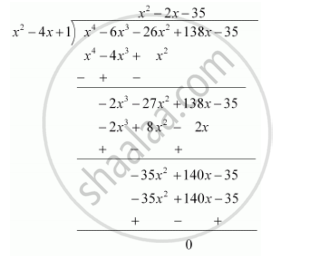
Clearly x4 - 6x3 - 26x2 + 138x - 35 = (x2 - 4x +1)(x2 -2x -35)

It can be observed that (x2 - 2x - 35) is also a factor of the given polynomial.

And (x2 - 2x - 35) = (x -7)(x + 5)

Therefore, the value of the polynomial is also zero when x - 7 = 0 or x + 5 = 0

or x = 7 or -5

Hence, 7 and - 5 are also zeroes of this polynomial

shaalaa.com

उत्तर २

2+√3 and 2-√3 are two zeroes of the polynomial p(x) = x4 – 6x3 – 26x2 + 138x – 35.

Let x = 2±√3

So, x-2 = ±√3

On squaring, we get x2 - 4x + 4 = 3,
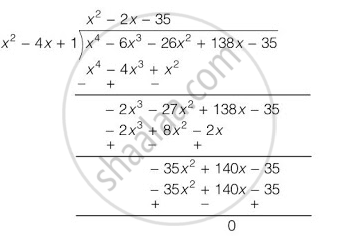
Now, dividing p(x) by x2 - 4x + 1
 
 
∴ p(x) = x4 - 6x3 - 26x2 + 138x - 35

= (x2 - 4x + 1) (x2 - 2x - 35)

= (x2 - 4x + 1) (x2 - 7x + 5x - 35)

= (x2 - 4x + 1) [x(x - 7) + 5 (x - 7)]

= (x2 - 4x + 1) (x + 5) (x - 7)

∴ (x + 5) and (x - 7) are other factors of p(x).

∴ - 5 and 7 are other zeroes of the given polynomial.
shaalaa.com
  या प्रश्नात किंवा उत्तरात काही त्रुटी आहे का?

व्हिडिओ ट्यूटोरियलVIEW ALL [2]

संबंधित प्रश्‍न

Find the zeros of the quadratic polynomial 4x2 - 9 and verify the relation between the zeros and its coffiecents.


Find the zeroes of the following quadratic polynomial and verify the relationship between the zeroes and the coefficients:

t2 – 15


Find a quadratic polynomial each with the given numbers as the sum and product of its zeroes respectively. 

`1/4 , -1`


If α and β are the zeros of the quadratic polynomial f(x) = ax2 + bx + c, then evaluate α - β


If α and β are the zeros of the quadratic polynomial f(x) = 6x2 + x − 2, find the value of `alpha/beta+beta/alpha`.


Find the zeroes of the polynomial f(x) = `2sqrt3x^2-5x+sqrt3` and verify the relation between its zeroes and coefficients. 


Find the zeroes of the quadratic polynomial` (x^2 ˗ 5)` and verify the relation between the zeroes and the coefficients.


Find all the zeroes of `(x^4 + x^3 – 23x^2 – 3x + 60)`, if it is given that two of its zeroes are `sqrt3 and –sqrt3`. 


If 𝛼, 𝛽 are the zeroes of the polynomial `f(x) = 5x^2 -7x + 1` then `1/∝+1/β=?` 


If α, β, γ are the zeros of the polynomial f(x) = ax3 + bx2 cx + d, then α2 + β2 + γ2 =


What should be added to the polynomial x2 − 5x + 4, so that 3 is the zero of the resulting polynomial?


If two zeroes of the polynomial x3 + x2 − 9x − 9 are 3 and −3, then its third zero is


If x + 2 is a factor of x2 + ax + 2b and a + b = 4, then


The number of polynomials having zeroes as –2 and 5 is ______.


Find the zeroes of the following polynomials by factorisation method and verify the relations between the zeroes and the coefficients of the polynomials:

4x2 – 3x – 1


For the following, find a quadratic polynomial whose sum and product respectively of the zeroes are as given. Also find the zeroes of these polynomials by factorisation.

`(-8)/3, 4/3`


Find the sum and product of the roots of the quadratic equation 2x2 – 9x + 4 = 0.


If α, β are zeroes of quadratic polynomial 5x2 + 5x + 1, find the value of α–1 + β–1.


Share
Notifications

Englishहिंदीमराठी


      Forgot password?
Use app×