Advertisements
Advertisements
प्रश्न
Obtain an expression for the torque acting on a rotating body with constant angular acceleration. Hence state the dimensions and SI unit of torque.
Obtain an expression for the torque acting on a rotating body with constant angular acceleration.
Obtain an expression relating the torque with angular acceleration for a rigid body.
Advertisements
उत्तर
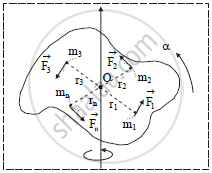
For m1, a1 = r1α
For m2, a2 = r2α
For mn, an = rnα
f1 = m1a1 = m1r1α
f2 = m2a2 = m2r2α
fn = mnrnα
Torque `(vec tau) = vec r xx vec f`
= r f sin 90°
τ = rf
τ1 = rf1 = `m_1 r_1^2alpha`
τ2 = `m_2 r_2^2 alpha`
τn = `m_n r_n^2 alpha`
τ = τ1 + τ2 + ... + τn
Total torque on the body,
`vec tau_"net" = vec tau_1 + vec tau_2 + vec tau_3 + ... vec tau_n`
= `m_1 r_1^2 alpha + m_2 r_2^2 alpha + ..... + m_n r_n^2 alpha`
= `alpha(m_1 r_1^2 + m_2 r_2^2 + ..... + m_n r_n^2)`
I = mr2
`vec tau_"net"` = (I1 + I2 + I3 + ...... In)α
= Iα
Dimension: [ML2T−2]
APPEARS IN
संबंधित प्रश्न
State the law of conservation of angular momentum and explain with a suitable example.
Obtain an expression for torque acting on a body rotating with uniform angular acceleration.
A 500 kg car takes a round turn of the radius of 50m with a velocity of 36 km/hr. The centripetal force is ______.
An electron(e) is revolving in a circular orbit of radius r in the hydrogen atom. The angular momentum of the electron is (M = magnetic dipole moment associated with it and m = mass of electron)
A stone of mass 1 kg is rotated in a horizontal circle of radius 0.5 m. If it makes `100/pi` rps, then its angular momentum is ______
A charged particle (charge = q: mass = m) is rotating in a circle of radius 'R' with uniform speed 'v'. The ratio of its magnetic moment (M) to the angular momentum (L) is ______
If the angular momentum of a body increases by 50%, then its kinetic energy of rotation increases by ______ (M.I. remains constant)
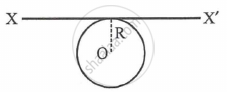
A thin metal wire of length 'L' and uniform linear mass density 'ρ' is bent into a circular coil with 'O' as centre. The moment of inertia of a coil about the axis XX' is ______.
If the kinetic energy of rotation of a body is doubled, then its angular momentum ____________.
Two bodies with moments of inertia I1 and I2 (I1 > I2) have equal angular momenta. lf E1 and E2 are their rotational kinetic energies respectively, then ____________.
A particle of mass m is rotating in a plane in a circular path of radius r. Its angular momentum is L. The centripetal force acting on the particle is ______.
If the angular momentum of an electron is `vec"J"` then the magnitude of the magnetic moment will be ____________.
A homogeneous disc of mass 2 kg and radius 15 cm is rotating about its axis (which is fixed) with an angular velocity of 4 radian/s. The linear momentum of the disc is ____________.
Let I1 and I2 be the moments of inertia of two bodies of identical geometrical shape. If the first body is made of aluminium and the second of iron, then ____________.
mass is whirled in a circular path with constant angular velocity and its linear velocity is v. If the string is now halved keeping the angular momentum same, the linear velocity is ______.
An electron has a mass of 9.1 x 10⁻³¹ kg. It revolves round the nucleus in a circular orbit of radius 0.529 x 10⁻¹⁰ metre at a speed of 2.2 x 10⁶ m/s. The magnitude of its linear momentum in this motion is ____________.
An electron of mass 'm' revolving around the nucleus in a circular orbit of radius 'r' has angular momentum 'L'. The magnetic field produced by the electron at the centre of the orbit is e = electric charge, µ0 = permeability of free space ____________.
lf 'I' is the moment of inertia and 'L' is angular momentum of a rotating body, then `L^2/(2I)` is its ______.
Three-point masses each of mass 'M' are placed at the corners of an equilateral triangle of side 'a'. The moment of inertia of this system about an axis passing through one side of a triangle is ______.
An electron in an atom is revolving round the nucleus in a circular orbit of radius 5.3 × 10⁻¹¹ m with a speed of 3 × 10⁶ m/s. Find the angular momentum of electron.
A wheel of moment of inertia 2 kg m2 is rotating about an axis passing through centre and perpendicular to its plane at a speed 60 rad/s. Due to friction, it comes to rest in 5 minutes. The angular momentum of the wheel three minutes before it stops rotating is ______.
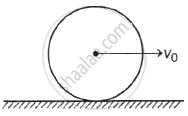
A sphere rolls without slipping on a rough horizontal surface with centre of mass speed v0. If mass of the sphere is M and its radius is R, then what is the angular momentum of the sphere about the point of contact?
Define angular momentum.
Two whistles A and B have frequencies 660 Hz and 590 Hz respectively. An observer is standing in the middle of the line joining the two sources. he middle of the line joining the two sources. Source B and observer are moving towards right with velocity 30 m/s and A is stationary at left side. The number of beats listened by the observer are ______.
(Velocity of sound in air = 300 m/s)
