Advertisements
Advertisements
प्रश्न
Name three factors on which the magnitude of force on a current carrying conductor placed in a magnetic field depends and state how does the force depend on the factors stated by you.
Advertisements
उत्तर
Experimentally, it is found that the magnitude of force acting on a current carrying conductor placed in a magnetic field in the direction perpendicular to it's length depends on the following three factors:
- The force F is directly proportional to the strength of magnetic field B, i.e., F α B
- The force F is directly proportional to the current I flowing in the wire, i.e., F α I
- The force F is directly proportional to the length L of the wire (within the magnetic field) i.e., F α L
APPEARS IN
संबंधित प्रश्न
State whether the following statement is true or false
The field at the centre of a long circular coil carrying current will be parallel straight lines.
Describe how you will locate a current-carrying wire concealed in a wall.
A soft iron bar is inserted inside a current-carrying solenoid. The magnetic field inside the solenoid:
(a) will decrease
(b) will increase
(c) will become zero
(d) will remain the same
A current-carrying conductor is held in exactly vertical direction. In order to produce a clockwise magnetic field around the conductor, the current should passed in the conductor:
(a) from top towards bottom
(b) from left towards right
(c) from bottom towards top
(d) from right towards left
A flat coil ABCD is freely suspended between the pole of U-shaped permanent magnet with the plane of coil parallel to the magnetic field.
What happens when a current is passed in the coil?
A coil ABCD mounted on an axle is placed between the poles N and S of a permanent magnet as shown in Figure.
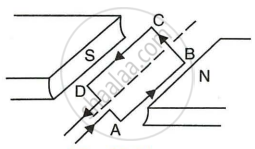
- In which direction will the coil begin to rotate when current is passed through the coil in direction ABCD by connecting a battery at the ends A and D of the coil?
- Why is a commutator necessary for continuous rotation of the coil?
- Complete the diagram with commutator, etc. for the flow of current in the coil?
Name the following diagram and explain the concept behind it.
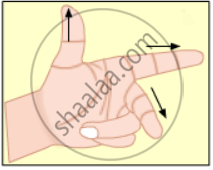
State Fleming’s left-hand rule.
A copper conductor is placed over two stretched copper wires whose ends ate connected to a D.C. supply as shown in the diagram.
- What should be the magnetic poles at the points A and B lying on either side of the conductor to experience the force in the upward direction?
- Name the law used to find these polarities.

|
The graph (fig A) illustrates the correlation between the number of protons (x-axis) and the number of neutrons (y-axis) for elements A, B, C, D, and E in the periodic table. These elements are denoted by the letters rather than their conventional symbols. When the element C, depicted in the graph, undergoes radioactive decay, it releases radioactive rays. When these rays are directed into the plane of the paper in the presence of a magnetic field, as indicated in the fig B, they experience deflection, causing them to move upwards.
|
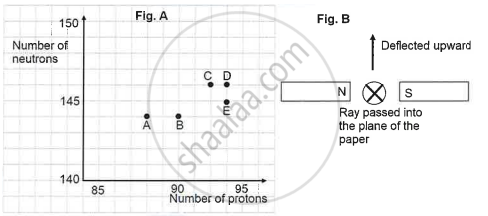
Name the law used to identify the radioactive radiation emitted by the element.
