Advertisements
Advertisements
प्रश्न
Name three factors on which the deviation produced by a prism depends and state how does it depend on the factors stated by you.
Advertisements
उत्तर
The following four factors affect the deviation the prism produces:
- The angle of incidence: As the angle of incidence increases, first the angle of deviation decreases and reaches a minimum value for a certain angle of incidence. By further increasing the angle of incidence, the angle of deviation is found to increase.
- The material of the prism (i.e., refractive index): for a given angle of incidence, the prism with a higher refractive index produces a greater deviation than the prism with a lower refractive index.
- Angle of prism: The angle of deviation increases with the increase in the angle of the prism.
- The colour or wavelength of light used increases the angle of deviation with a decrease in the wavelength of light.
APPEARS IN
संबंधित प्रश्न
How does the deviation produced by a triangular prism depend on the colours (or wavelengths) of light incident on it?
In following figure shows a thin beam of white light from a source S striking on one face of a prism.
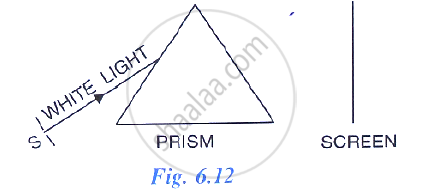
Complete the diagram to show effect of prism on the beam and to show what is seen on the screen.
In following diagram shows a thin beam of white light from a source S striking on one face of a prism.
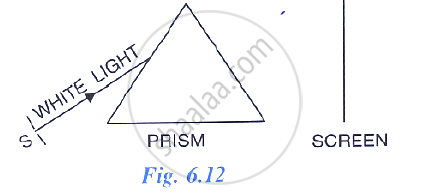
A slit is placed in between the prism and the screen to pass only the light of green colour. What will you then observe on the screen?
If a monochromatic beam of light undergoes minimum deviation through an equiangular prism, how does the beam pass through the prism, with respect to its base?
(i) Draw a diagram to show the splitting of white light by a prism into its constituent colour.
(ii) Draw another diagram to show how the colours of spectrum of white light can be combined
to give the effect of white light.
Write the approximate wavelengths for blue.
Light of different colours is deviated through different angles by a prism. Explain the reason.
Explain, why quartz prism is required for obtaining the spectrum of ultra-violet light?
The wavelengths for the light of red and blue colours are nearly 7·8 × 10-7 m and 4·8 × 10-7 m respectively.
Which colour has greater speed in glass?
