Advertisements
Advertisements
प्रश्न
Name the following:
The main mineral constituent of chlorophyll.
Advertisements
उत्तर
Magnesium
APPEARS IN
संबंधित प्रश्न
A healthy oat seeding in a pot is transferred from light to any airy but completely dark room. How would it differ from its original condition in appearance after about a week? Explain the difference.
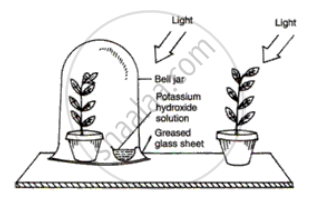
Two healthy green plants were placed in the dark for 24 hours. They were then set up, as shown in the figure, for 4 hours. Then a leaf was taken from each plant and
the chlorophyll was removed from the leaves:
( i) What is the next and final step in this experiment?
( ii ) What would be the results of the final step?
( iii ) Why was it necessary to grease the glass sheet?
( iv ) What hypothesis is being tested in this experiment?
Complete the following statement by choosing the correct alternative given below :
All animals would die on the earth if there was no ______.
The chemical substance used to test the presence of starch in the cell of a leaf is ______.
All life owes its existence to chlorophyll. Give reason.
Complete the following by filling the blanks 1 to 5 with appropriate words/terms/phrases:
To test the leaf for starch, the leaf is boiled in water to ______ (1). It is next boiled in methylated spirit to ______ (2). The leaf is placed in warm water to soften it. It is then placed in a dish and ______ (3) solution is added. The region which contains starch, turns ______ (4) and the region which does not contain starch, turns ______ (5)
Given below is the representation of a certain phenomenon in nature. With four organisms 1-4.

- Name the phenomenon represented.
- Name any one organism that could be shown at No. 5.
- Name the biological process which was the starting point of the whole chain.
- Name one natural element which all the organisms 2-4 and even 5 are getting from No. 1 for their survival.
Given alongside is the diagram of an experimental set-up:
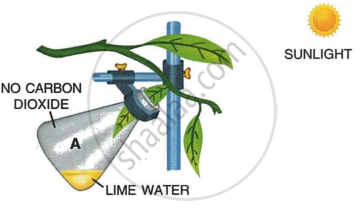
- What is the objective of this experiment?
- Will it work satisfactorily? Give reason.
- What alteration(s) will you make in it for obtaining expected result?
- Would you take any steps before starting the experiment? Describe this step and explain its necessity.
ATP is needed for the dark reaction.
Complete the following sentence with appropriate word:
________molecules of chlorophyll make one quantasome.
