Advertisements
Advertisements
प्रश्न
Mention three advantages of Conservation Tillage.
State any two advantages of conservation tillage.
Advertisements
उत्तर १
- Seedbed preparation
- Increase in nutrient use efficiency
- Weed control
- Evaporation suppression
- Water infiltration enhancement and improved water-retention capacity
- Erosion control and maintains the productivity of upland soils by reducing erosion
- Maintains a favourable soil temperature
These benefits together result in increased and sustained crop yields.
उत्तर २
Conservation tillage is a tillage method that leaves the previous year’s crop residue on fields before and after planting the next crop to reduce soil erosion and runoff.
Advantages of conservation tillage are:
- It conserves water by reducing evaporation at the soil surface.
- It conserves energy, time, fuel, and money by reducing the number of trips across the field. The cost of labour and machinery is also lessened.
- Reducing potential air pollution from dust and diesel emissions.
- Crop residue provides food and cover for wildlife.
- Improves soil moisture by enhancing crop growth in dry periods or on droughty soils.
Notes
Students should refer to the answer according to their questions.
APPEARS IN
संबंधित प्रश्न
Growing of two or more crops in the same field is called ______.
Give one difference between Polyvarietal cultivation and Polyculture.
State any three of its importance in sustainable agriculture.
Mention two advantages Trickle or Drip Irrigation.
State any two disadvantages of Mixed Cropping.
Write three advantages of Integrated Pest Management (IPM).
Write the expanded form of GMO.
Write two problems associated with GMO organisms.
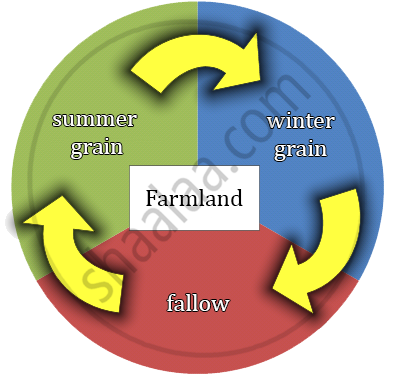
What type of regenerative farming technique is depicted in the image given below?
Explain the role of Gene Bank in agricultural research.
