Advertisements
Advertisements
प्रश्न
Match the pairs.
| Group ‘A’ | Group ‘B’ |
| (a) Flute | (1) Frequency less than 20 Hz |
| (b) Frequency | (2) Frequency more than 20000 Hz |
| (c) Sound level | (3) Vibrations in the air |
| (d) Ultrasonic sound | (4) Measured in Hz |
| (e) Infrasonic sound | (5) Decibel |
Advertisements
उत्तर
| Group ‘A’ | Group ‘B’ |
| (a) Flute | (3) Vibrations in the air |
| (b) Frequency | (4) Measured in Hz |
| (c) Sound level | (5) Decibel |
| (d) Ultrasonic sound | (2) Frequency more than 20000 Hz |
| (e) Infrasonic sound | (1) Frequency less than 20 Hz |
संबंधित प्रश्न
Which wave property determines (a) loudness, (b) pitch?
A musician recognizes the musical instrument by hearing the sound produced by it, even without seeing the instrument. Which characteristic of sound makes this possible ?
Name the type of waves produced when a tuning fork is struck in air.
Which one of the following does not consist of transverse waves?
How does the velocity of a wave vary with temperature?
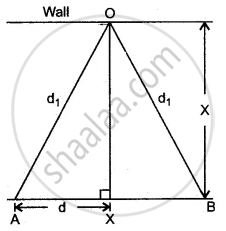
A cannon is fired at A (see diagram). An observer at B hears two sounds. The first sound is heard after 1 second and the second 3s after the observer sees the flash. (Velocity of sound = 340 ms−1)
(i) Why does the observer see the flash before he hears the sound?
(ii) Calculate the distance x between the observer and the wall.
Select the correct option:
If the frequency of a wave is 25 Hz. the total number of compressions and rarefactions passing through a point in 1 second is :
A continuous progressive transverse wave of frequency 8 Hz moves across the surface of a ripple tank
With reference to the frequency, describe the movement of water on the surface
Match the following
| 1. | Infrasonic | (a) | Compressions |
| 2. | Echo | (b) | 22 kHz |
| 3. | Ultrasonic | (c) | 10 Hz |
| 4. | High-pressure region | (d) | Ultrasonography |
