Advertisements
Advertisements
प्रश्न
Match the following
| column A | column B |
| (A) Amplitude | (1) frequency |
| (B) Frequency | (2) amplitude |
| (C) Loudness | (3)maximum displacement on either side |
| (D) Pitch | (4) presence of other frequencies |
| (E) Waveform | (5) 1/ time period |
Advertisements
उत्तर
| column A | column B |
| (A) Amplitude | (3) maximum displacement on either side |
| (B) Frequency | (5) 1/ time period |
| (C) Loudness | (2) amplitude |
| (D) Pitch | (1) frequency |
| (E) Waveform | (4) presence of other frequencies |
APPEARS IN
संबंधित प्रश्न
Shrillness of a sound is determined by the ______ of vibration.
State one important property of waves used for echo depth sounding.
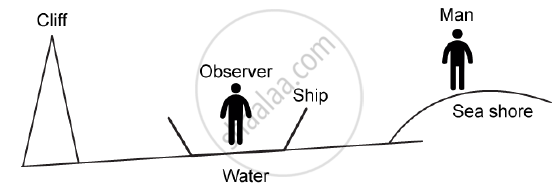
A person is standing at the seashore. An observer on the ship which is anchored in between a vertical cliff and the person on the shore fires a gun. The person on the shore hears two sounds, 2 seconds and 3 seconds after seeing the smoke of the fired gun. If the speed of sound in the air is 320 ms-1 then calculate:
1) the distance between the observer on the ship and the person on the shore.
2) the distance between the cliff and the observer on the ship.
How is the pitch of sound in a guitar changed if (a) thin wire is used, (b) wire under less tension is used?
Name three characteristics of a musical sound.
How do you account for the fact that two strings can be used to give notes of the same pitch and loudness but of different quality?
Draw a diagram to show the waveforms of a pure note and a musical note, of the same pitch and same loudness.
Give a scientific reason.
In earlier times, people used to listen for the arrival of a distant train by putting their ear to the rail.
