Advertisements
Advertisements
प्रश्न
Give a scientific reason.
We can hear the movement of a mosquito’s wings but we cannot hear the movement of our hands.
Advertisements
उत्तर
The frequency of the sound produced by the movement of a mosquito’s wings lies within the human audible range (20 Hz to 20,000 Hz), whereas the sound produced by the movement of our hands has a frequency below 20 Hz, which is inaudible to humans. Therefore, we can hear the movement of a mosquito's wings but not that of our hands.
संबंधित प्रश्न
The lower the frequency of vibration, the higher is the pitch.
A pendulum oscillates 40 times in 4 seconds. Find its time period and frequency.
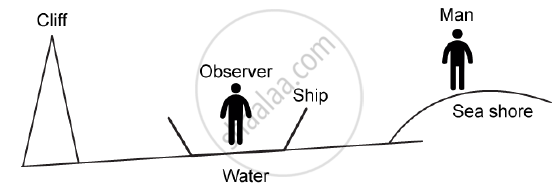
A person is standing at the seashore. An observer on the ship which is anchored in between a vertical cliff and the person on the shore fires a gun. The person on the shore hears two sounds, 2 seconds and 3 seconds after seeing the smoke of the fired gun. If the speed of sound in the air is 320 ms-1 then calculate:
1) the distance between the observer on the ship and the person on the shore.
2) the distance between the cliff and the observer on the ship.
In a piano, pitch is decreased by
Obtain relationship between the time period and frequency.
Name three characteristics of a musical sound.
If the amplitude of a wave is doubled, what will be the effect on its loudness?
It is observed that during march-past we hear a base drum distinctly from a distance compared to the side drums.
(i) Name the characteristics of sound associated with the above obervation.
(ii) Give a reason for the above observation.
Name musical instrument, one in each case, which produces its notes by using the following. In each case state the method used to produce notes of different pitches and loudness.
(a) A vibrating string.
(b) A vibrating column air.
(c) Vibration of any other body.
Name the factors which determine the quality of a note.
