Match the following. 1. Length kelvin 2. Mass metre 3. Time kilogram 4. Temperature second
Advertisements
प्रश्न
Match the following.
| 1. | Length | kelvin |
| 2. | Mass | metre |
| 3. | Time | kilogram |
| 4. | Temperature | second |
Advertisements
उत्तर
| 1. | Length | metre |
| 2. | Mass | kilogram |
| 3. | Time | second |
| 4. | Temperature | kelvin |
APPEARS IN
संबंधित प्रश्न
The principle of ‘parallax’ in section 2.3.1 is used in the determination of distances of very distant stars. The baseline AB is the line joining the Earth’s two locations six months apart in its orbit around the Sun. That is, the baseline is about the diameter of the Earth’s orbit ≈ 3 × 10¹¹m. However, even the nearest stars are so distant that with such a long baseline, they show parallax only of the order of 1” (second) of arc or so. A parsec is a convenient unit of length on the astronomical scale. It is the distance of an object that will show a parallax of 1” (second) of arc from opposite ends of a baseline equal to the distance from the Earth to the Sun. How much is a parsec in terms of meters?
Just as precise measurements are necessary in science, it is equally important to be able to make rough estimates of quantities using rudimentary ideas and common observations. Think of ways by which you can estimate the following (where an estimate is difficult to obtain, try to get an upper bound on the quantity):
the number of strands of hair on your head
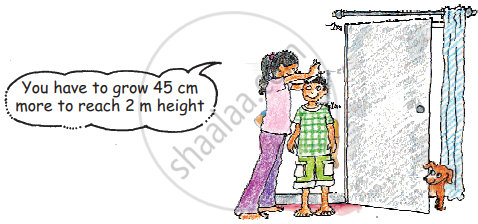
What is Dinesh’s height in metres? _____ m _____ cm.
How close was your earlier guess? Discuss.
Arbaz plans to tile his kitchen floor with green square tiles. Each side of the tile is 10 cm. His kitchen is 220 cm in length and 180 cm wide. How many tiles will he need?

Give some examples of larger length measures.
The distance between one end and the other end is called ______.
What unit will you use to measure the length of our classroom?
In the parallax formula D = b/θ, what must be true about the angle θ for the calculation to be correct?
If a planet subtends an angle α at distance D, what formula is used to find the planet's diameter?
