Advertisements
Advertisements
प्रश्न
Arbaz plans to tile his kitchen floor with green square tiles. Each side of the tile is 10 cm. His kitchen is 220 cm in length and 180 cm wide. How many tiles will he need?

Advertisements
उत्तर
- Area of floor
= length x width
= 220 x 180
= 39600 square cm - Area of a tile
= Side x Side
= 10 x 10
= 100 square cm - Number of tiles
= Area of floor + Area of tile
= 39600 + 100
= 396 tiles
संबंधित प्रश्न
When the planet Jupiter is at a distance of 824.7 million kilometres from the Earth, its angular diameter is measured to be 35.72″ of arc. Calculate the diameter of Jupiter
Answer the following question.
Star A is farther than star B. Which star will have a large parallax angle?
500 gm = ______ kilogram.
Fill in the following chart.
| Property | Definition | Basic Unit | Instrument used for measuring |
| Length | |||
| Mass | |||
| Volume | |||
| Time |
Metre is the unit of ______.
Assertion (A): Distance between two celestial bodies is measured in terms of light year.
Reason (R): The distance travelled by the light in one year is one light year.
Which line is longer? C or D? Measure each line. How good is your guess?

Now cut strips of equal sizes out of it. Using tape join the strips, end to end, to make a belt.
How long is your belt? _________
You can play this game on the ground. Make two squares of one square meter each. Divide your class into two teams. Ready to play!
- How many of you can sit in one square meter?
Chumki, Jhumri, and Imran need wire to make a fence.
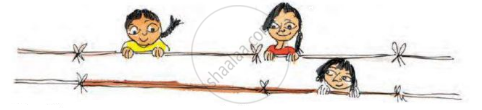
- How much wire in all will the three need?
So Anar also tried many different ways to make a boundary for 800 square meters of land.
He made rectangles A, B, and C of different sizes. Find out the length of the boundary of each. How much gold wire will he get for these rectangles?
- A
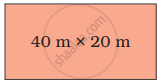
Gold wire for A = _________ metres - B

Gold wire for B = _________ metres - C

Gold wire for C = __________ metres
But then Anar made an even longer rectangle... See how long!
- D

So he will get __________ metres of gold wire!!
There are two beautiful lakes near a village. People come for boating and picnics in both the lakes. The village Panchayat is worried that with the noise of the boats the birds will stop coming. The Panchayat wants motorboats in only one lake. The other lake will be saved for the birds to make their nests.
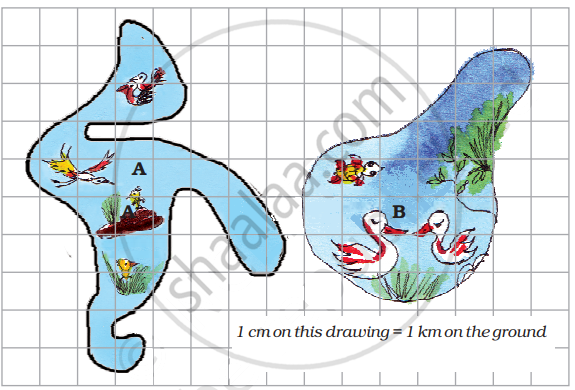
- A longer boundary around the lake will help more birds to lay their eggs. So which lake should be kept for birds? Which lake should be used for boats?
Give some examples of larger length measures.
What is the unit of measurements of very small lengths?
Larger unit for measuring time is ______.
In an experiment to estimate the size of a molecule of oleic acid 1 mL of oleic acid is dissolved in 19 mL of alcohol. Then 1 mL of this solution is diluted to 20 mL by adding alcohol. Now 1 drop of this diluted solution is placed on water in a shallow trough. The solution spreads over the surface of water forming one molecule thick layer. Now, lycopodium powder is sprinkled evenly over the film and its diameter is measured. Knowing the volume of the drop and area of the film we can calculate the thickness of the film which will give us the size of oleic acid molecule.
Read the passage carefully and answer the following questions:
- Why do we dissolve oleic acid in alcohol?
- What is the role of lycopodium powder?
- What would be the volume of oleic acid in each mL of solution prepared?
- How will you calculate the volume of n drops of this solution of oleic acid?
- What will be the volume of oleic acid in one drop of this solution?
Why is Earth's orbit used instead of its diameter to measure distances to stars using the parallax method?
Why is the speed of light used to define the metre?
