Advertisements
Advertisements
प्रश्न
Match the column (A) with the column (B)
| (A) | (B) | ||
| (a) | Parenchyma | (i) | Thin walled, packing cells |
| (b) | Photosynthesis | (ii) | Carbon fixation |
| (c) | Aerenchyma | (iii) | Localized thickenings |
| (d) | Collenchyma | (iv) | Buoyancy |
| (e) | Permanent tissue | (v) | Sclerenchyma |
जोड्या लावा/जोड्या जुळवा
Advertisements
उत्तर
| (A) | (B) | ||
| (a) | Parenchyma | (i) | Thin walled, packing cells |
| (b) | Photosynthesis | (ii) | Carbon fixation |
| (c) | Aerenchyma | (iv) | Buoyancy |
| (d) | Collenchyma | (iii) | Localized thickenings |
| (e) | Permanent tissue | (v) | Sclerenchyma |
shaalaa.com
या प्रश्नात किंवा उत्तरात काही त्रुटी आहे का?
APPEARS IN
संबंधित प्रश्न
How are simple tissues different from complex tissues in plants?
Draw a well-labelled diagram of phloem.
Distinguish between tracheids and vessels.
Explain how sieve tubes manage to be living?
Name one place in a living organism where the following tissues are located:
Sclerenchyma
Study the diagram given below and then answer the question that follows:
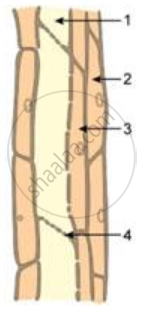
State the function of the parts labelled 1, 2, 3 and 4.
Write 'True or False' for the following statement:
A tracheid is longer than a vessel.
The question has four answers. Choose the correct answer:
Collenchymatous hypodermis is found in
Name any two simple and two complex permanent tissues in plants.
Which of the following is a permanent tissue?
