Advertisements
Advertisements
प्रश्न
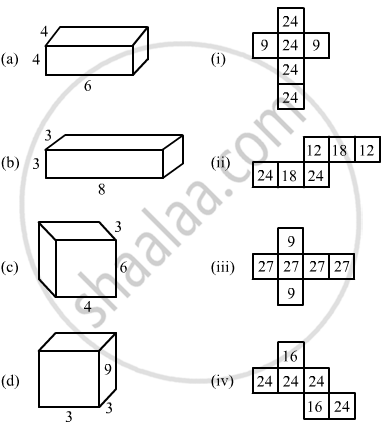
Match the following figure:
Advertisements
उत्तर
(a) The given figure is a cuboid with sides 4, 4 and 6 units.
\[\text { Area of a rectangle } =\text { length }\times \text { width}\]
\[ \therefore \text{Area of the rectangular face sith sides 4 and} 4 =4 \times 4=16\]
\[\text { And, area of the other face with sides 4 and 6 }=4 \times 6=24 \]
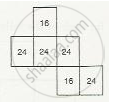
Thus, the net for the given figure will have four faces with area 24 and two faces with area 16.
Observe net (iv) satisfies this.
Thus, the net of figure (a) is net (iv).
(b) The given figure is a cuboid with sides 3, 3 and 8.
\[\text { Area of arectangle }=\text { length }\times \text { width }\]
\[\therefore \text { Area of the rectangular face sith sides 3 and 3 =3 }\times3=9\]
\[\text { And the area of the other face with sides 3 and 8 } =3\times8=24\]
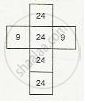
\[\text { Thus, the net for given figure will have four faces with area 24 and two faces with area 9 }.\]
\[\text { Observe that net (i) satisfies this}.\]
\[\text { Thus, the net of figure (b) is net } (i).\]
(c)The given figure is a cuboid with sides 3, 4 and 6.
\[\text { Area of a rectangle }=\text { length }\times \text { width }\]
\[ \therefore \text { Area of the rectangular face sith sides 3 and 4 =3 }\times4=12,\]
\[\text { Area of the rectangular face with sides 4 and 6 =4 }\times6=24\]
\[\text { And, area of the other face with sides 3 and 6 =3 }\times6=18\]
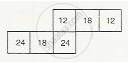
\[\text { Thus, the net for given figure will have two faces with area 24, two faces with area 18 and two faces with area 12. }\]
Observe that net (ii) satisfies this.
Thus, the net of figure (c) is net (ii).
(d) The given figure is a cuboid with sides 3, 3 and 9.
\[\text { Area of arectangle=length }\times \text { width }\]
\[\text { Area of the rectangular face with sides 3 and 3 =3 }\times3=9,\]
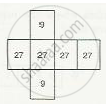
\[\text { And, area of the other face with sides 3 and 9 =3 }\times9=27\]
\[\text { Thus, the net for given figure will have four faces with area 27 and two faces with area 9 }.\]
Observe that net (iii) satisfies this.
Thus, the net of figure (d) is net (iii).
संबंधित प्रश्न
Can a polyhedron have for its faces 3 triangles?
Can a polyhedron have for its faces 4 triangles?
The given Figure are prisms or not?
Verify Euler’s formula for given solids

Verify Euler’s formula for given solids.

Is it possible to have a polyhedron with any given number of faces?
Using Euler's formula find the unknown:
| Faces | ? | 5 | 20 |
| Vertices | 6 | ? | 12 |
| Edges | 12 | 9 | ? |
Draw at least three different nets for making a cube.
The figure, given below, shows shadows of some 3D object when seen under the lamp of an overhead projector:
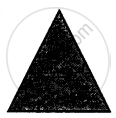
A triangle
In this case, name the object.
The number of edges in a parallelogram is 4.
