Advertisements
Advertisements
प्रश्न
Match the following.
| Column A | Column B |
| (1) Length | a. kilogram |
| (2) Mass | b. cubic metre |
| (3) Area | c. metre |
| (4) Volume | d. square metre |
Advertisements
उत्तर
| Column A | Column B |
| (1) Length | c. metre |
| (2) Mass | a. kilogram |
| (3) Area | d. square metre |
| (4) Volume | b. cubic metre |
APPEARS IN
संबंधित प्रश्न
The nearest star to our solar system is 4.29 light years away. How much is this distance in terms of parsecs? How much parallax would this star (named Alpha Centauri) show when viewed from two locations of the Earth six months apart in its orbit around the Sun?
500 gm = ______ kilogram.
Ten millimetre makes one centimetre.
Rulers, measuring tapes and metre scales are used to measure ______
Match the following.
| 1. | Length | kelvin |
| 2. | Mass | metre |
| 3. | Time | kilogram |
| 4. | Temperature | second |
Guess whose tail is the longest. Now measure the tails. How good is your guess?


There are two beautiful lakes near a village. People come for boating and picnics in both the lakes. The village Panchayat is worried that with the noise of the boats the birds will stop coming. The Panchayat wants motorboats in only one lake. The other lake will be saved for the birds to make their nests.
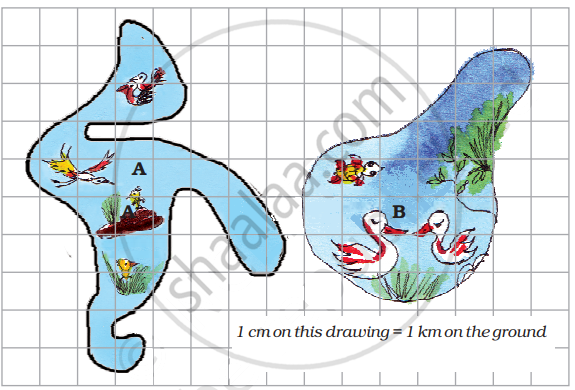
- How many kilometers long is the actual boundary of lake B?
In which SI unit, you can measure your height?
The distance of a galaxy is of the order of 1025 m. Calculate the order of magnitude of time taken by light to reach us from the galaxy.
In the parallax formula D = b/θ, what must be true about the angle θ for the calculation to be correct?
