Advertisements
Advertisements
प्रश्न
Mark two points A and B ,4cm a part, Draw a circle passing through B and with A as a center

Advertisements
उत्तर
In the above figure, A is the centre of the circle and AB = 4 cm [radius of circle].
APPEARS IN
संबंधित प्रश्न
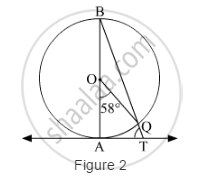
In Fig. 2, AB is the diameter of a circle with centre O and AT is a tangent. If ∠AOQ = 58°, find ∠ATQ.
Fill in the blanks:
Segment of a circle is the region between an arc and __________ of the circle.
ture or false v
The degree measure of a semi-circle is 180°.
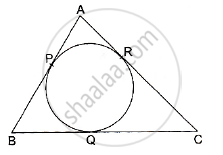
A circle is inscribed in a ΔABC touching AB, BC and AC at P, Q and R respectively. If AB = 10 cm, AR = 7 cm and CR = 5 cm, find the length of BC.
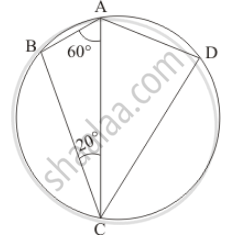
In the given figure, if ∠BAC = 60° and ∠BCA = 20°, find ∠ADC.
The ratio between the circumference and diameter of any circle is _______
A point P is 10 cm from the center of a circle. The length of the tangent drawn from P to the circle is 8 cm. The radius of the circle is equal to ______
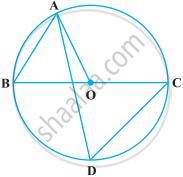
In the following figure, BC is a diameter of the circle and ∠BAO = 60º. Then ∠ADC is equal to ______.
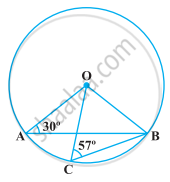
In the following figure, ∠OAB = 30º and ∠OCB = 57º. Find ∠BOC and ∠AOC.
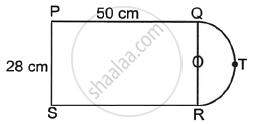
A figure is in the form of rectangle PQRS having a semi-circle on side QR as shown in the figure. Determine the area of the plot.