Advertisements
Advertisements
प्रश्न
List out the uses of magnets.
दीर्घउत्तर
Advertisements
उत्तर
- In ancient times, the magnet in the form of ‘direction stone’ helped seamen to find the directions during a voyage.
- Nowadays, magnets are used to generate electricity in dynamos.
- Electromagnets are used in our day-to-day life.
- They are used in electric bells and electric motors.
- They are used in loudspeakers and microphones.
- An extremely powerful electromagnet is used in the fast-moving Maglev train to remain floating above the tracks.
- In industries, magnetic conveyor belts are used to sort out magnetic substances from scraps mixed with non-magnetic substances.
- Magnets are used in computers in their storing devices such as hard disks.
- In banks, the magnets enable the computers to read the MICR numbers printed on a cheque.
- The tip of the screw drivers is made slightly magnetic so that the screws remain attached to the tip.
- At hospitals, extremely strong electro magnets are used in the MRI (Magnetic Resonance Imaging) to scan the specified internal organ.
shaalaa.com
या प्रश्नात किंवा उत्तरात काही त्रुटी आहे का?
APPEARS IN
संबंधित प्रश्न
“Poles exist in pair”. Comment on this statement ?
Write true or false of the following statement.
Magnetic keeper is a wooden piece.
How will you do this?
Find the north pole of a magnet.
Write the answer in your word.
Write the properties of a magnet.
Select the correct option:
The place around a magnet where its influence can be detected is called:
Bar magnets are often stored in pairs as shown in the figure. E and F being pieces of metal.
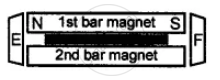
Why are E and F placed in contact with the poles of the magnets as shown in the diagram?
What do you understand by poles of a magnet?
Define the term Magnetic axis
Artificial magnets are made in different shapes such as ______, _____ and _______.
Define electromagnet.
