Advertisements
Advertisements
प्रश्न
Let there be n resistors R1............Rn with Rmax = max (R1......... Rn) and Rmin = min {R1..... Rn}. Show that when they are connected in parallel, the resultant resistance RP < R min and when they are connected in series, the resultant resistance RS > Rmax. Interpret the result physically.
Advertisements
उत्तर
Parallel grouping: Same potential difference appeared across each resistance but current distributes in the reverse ratio of their resistance, i.e. `i oo 1/R`

Series grouping: Same current flows through each resistance but potential difference distributes in the ratio of resistance, i.e. `V oo R`

In parallel combination: When all resistances are connected in parallel, the equivalent resistance Rρ is given by
`1/R_ρ = 1/R_1 + ... + 1/R_n`
By multiplying both sides by Rmin, we have
`R_(min)/R_ρ = R_(min)/R_1 + R_(min)/R_2 + ... + R_(min)/R_n`
Here, in RHS, there exists one term `R_(min)/R_(min)` = 1 and other terms are positive, so we have
`R_(min)/R_ρ = R_(min)/R_1 + R_(min)/R_2 + ... + R_(min)/R_n > 1`
This shows that the resultant resistance Rρ < Rmin.
Thus, in parallel combination, the equivalent resistance of resistors is even less than the minimum resistance available in a combination of resistors.
In series combination: When all resistances are connected in series, the equivalent resistance Rs is given by
Rs = R1 + ... + Rn
Here, in RHS, there exist one term having resistance Rmax.
So, we have
or Rs = R1 + ... + Rmax ... + ... + Rn
Rs = R1 + ... + Rmax ... + Rn = Rmax + ... (R1 + ... + )Rn
or Rs ≥ Rmax
Rs = Rmax(R1 + ... + Rn)
Thus, in series combination, the equivalent resistance of resistors is greater than the maximum resistance available in a combination of resistors.
Physical interpretation:
 (a) |
 (b) |
In figure (b), Rmin provides an equivalent routine as in figure. (a) for current. But in addition, there are (n – 1) routes by the remaining (n – 1) resistors. Current in figure. (b) is greater than current in figure (a) Effective resistance in figure. (b) < Rmin. Second circuit evidently affords a greater resistance.
 (c) |
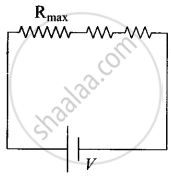 (d) |
In figure (d), Rmax provides an equivalent route as in figure. (c) for current. Current in figure (d) < current in figure (c). Effective resistance in figure. (d) > Rmax. Second circuit evidently affords a greater resistance.
