मराठी

Let a = `[(0,1),(0,0)]`Show that (Ai+Ba)N = Ani + Nan-1 Ba , Where I Is the Identity Matrix of Order 2 And N ∈ N - Mathematics

Advertisements
Advertisements

प्रश्न

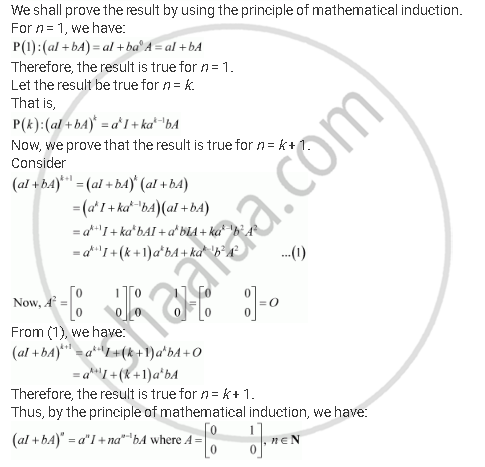
Let A = `[(0,1),(0,0)]`show that (aI+bA)n  = anI + nan-1 bA , where I is the identity matrix of order 2 and n ∈ N

Advertisements

उत्तर

It is given that  A = `[(0,1),(0,0)]`
shaalaa.com
  या प्रश्नात किंवा उत्तरात काही त्रुटी आहे का?
पाठ 3: Matrices - Exercise 3.5 [पृष्ठ १००]

APPEARS IN

एनसीईआरटी Mathematics Part 1 and 2 [English] Class 12
पाठ 3 Matrices
Exercise 3.5 | Q 1 | पृष्ठ १००

व्हिडिओ ट्यूटोरियलVIEW ALL [2]

संबंधित प्रश्‍न

If A is a square matrix, such that A2=A, then write the value of 7A(I+A)3, where I is an identity matrix.


if A = [(1,1,1),(1,1,1),(1,1,1)], Prove that A" = `[(3^(n-1),3^(n-1),3^(n-1)),(3^(n-1),3^(n-1),3^(n-1)),(3^(n-1),3^(n-1),3^(n-1))]` `n in N`


If A and B are square matrices of the same order such that AB = BA, then prove by induction that AB" = B"A. Further, prove that (AB)" = A"B" for all n ∈ N


If A = `[(alpha, beta),(gamma, -alpha)]` is such that A2 = I then ______.


Use product `[(1,-1,2),(0,2,-3),(3,-2,4)][(-2,0,1),(9,2,-3),(6,1,-2)]` to solve the system of equations x + 3z = 9, −x + 2y − 2z = 4, 2x − 3y + 4z = −3


If A and B are square matrices of order 3 such that |A| = –1, |B| = 3, then find the value of |2AB|.


A coaching institute of English (subject) conducts classes in two batches I and II and fees for rich and poor children are different. In batch I, it has 20 poor and 5 rich children and total monthly collection is Rs 9,000, whereas in batch II, it has 5 poor and 25 rich children and total monthly collection is Rs 26,000. Using matrix method, find monthly fees paid by each child of two types. What values the coaching institute is inculcating in the society?


Show that a matrix A = `1/2[(sqrt2,-isqrt2,0),(isqrt2,-sqrt2,0),(0,0,2)]` is unitary.


If\[A = \begin{bmatrix}2 & 3 \\ 4 & 5\end{bmatrix}\]prove that A − AT is a skew-symmetric matrix.


Show that (A + A') is symmetric matrix, if `A = ((2,4),(3,5))`


Choose the correct alternative.

The matrix `[(8, 0, 0),(0, 8, 0),(0, 0, 8)]` is _______


Classify the following matrix as, a row, a column, a square, a diagonal, a scalar, a unit, an upper triangular, a lower triangular, a symmetric or a skew-symmetric matrix:

`[(6, 0),(0, 6)]`


Classify the following matrix as, a row, a column, a square, a diagonal, a scalar, a unit, an upper triangular, a lower triangular, a symmetric or a skew-symmetric matrix:

`[(3, 0, 0),(0, 5, 0),(0, 0, 1/3)]`


Identify the following matrix is singular or non-singular?

`[(7, 5),(-4, 7)]`


Find k if the following matrix is singular:

`[(7, 3),(-2, "k")]`


Find k if the following matrix is singular:

`[("k" - 1, 2, 3),(3, 1, 2),(1, -2, 4)]`


Find x, y, z If `[(0, -5"i", x),(y, 0, z),(3/2, -sqrt(2), 0)]` is a skew symmetric matrix.


The following matrix, using its transpose state whether it is symmetric, skew-symmetric, or neither:

`[(1, 2, -5),(2, -3, 4),(-5, 4, 9)]`


The following matrix, using its transpose state whether it is symmetric, skew-symmetric, or neither:

`[(0, 1 + 2"i", "i" - 2),(-1 - 2"i", 0, -7),(2 - "i", 7, 0)]`


If A = `[(1, 0),(-1, 7)]`, find k so that A2 – 8A – kI = O, where I is a unit matrix and O is a null matrix of order 2.


Select the correct option from the given alternatives:

Given A = `[(1, 3),(2, 2)]`, I = `[(1, 0),(0, 1)]` if A – λI is a singular matrix then _______


Choose the correct alternative:

If A = `[(2, 0),(0, 2)]`, then A2 – 3I = ______


State whether the following statement is True or False:

If A is non singular, then |A| = 0


The matrix A = `[(0, 0, 5),(0, 5, 0),(5, 0, 0)]` is a ______.


For the non singular matrix A, (A′)–1 = (A–1)′.


If A is a square matrix, then A – A’ is a ____________.


If a matrix A is both symmetric and skew-symmetric, then ____________.


The matrix A `=[(0,1),(1,0)]` is a ____________.


`root(3)(4663) + 349` = ? ÷ 21.003


A matrix is said to be a row matrix, if it has


A square matrix B = [bÿ] m × m is said to be a diagonal matrix if all diagonal elements are


If A = `[(0, -tan  θ/2),(tan  θ/2, 0)]` and (I2 + A) (I2 – A)–1 = `[(a, -b),(b, a)]` then 13(a2 + b2) is equal to ______. 


Share
Notifications

Englishहिंदीमराठी


      Forgot password?
Use app×