Advertisements
Advertisements
प्रश्न
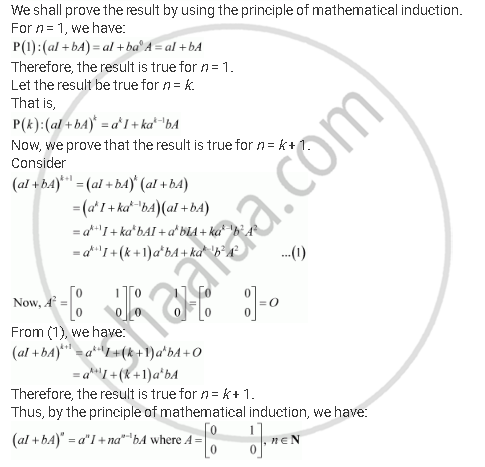
Let A = `[(0,1),(0,0)]`show that (aI+bA)n = anI + nan-1 bA , where I is the identity matrix of order 2 and n ∈ N
Advertisements
उत्तर
It is given that A = `[(0,1),(0,0)]`
APPEARS IN
संबंधित प्रश्न
Find the value of x, y, and z from the following equation:
`[(4,3),(x,5)] = [(y,z),(1,5)]`
Find the value of x, y, and z from the following equation:
`[(x+y+z), (x+z), (y+z)] = [(9),(5),(7)]`
Use product `[(1,-1,2),(0,2,-3),(3,-2,4)][(-2,0,1),(9,2,-3),(6,1,-2)]` to solve the system of equations x + 3z = 9, −x + 2y − 2z = 4, 2x − 3y + 4z = −3
Given two matrices A and B
`A = [(1,-2,3),(1,4,1),(1,-3, 2)] and B = [(11,-5,-14),(-1, -1,2),(-7,1,6)]`
find AB and use this result to solve the following system of equations:
x - 2y + 3z = 6, x + 4x + z = 12, x - 3y + 2z = 1
If A and B are square matrices of order 3 such that |A| = –1, |B| = 3, then find the value of |2AB|.
Find the non-singular matrices P & Q such that PAQ is in normal form where`[(1,2,3,4),(2,1,4,3),(3,0,5,-10)]`
If li, mi, ni, i = 1, 2, 3 denote the direction cosines of three mutually perpendicular vectors in space, prove that AAT = I, where \[A = \begin{bmatrix}l_1 & m_1 & n_1 \\ l_2 & m_2 & n_2 \\ l_3 & m_3 & n_3\end{bmatrix}\]
If\[A = \begin{bmatrix}2 & 3 \\ 4 & 5\end{bmatrix}\]prove that A − AT is a skew-symmetric matrix.
Show that (A + A') is symmetric matrix, if `A = ((2,4),(3,5))`
if `vec"a"= 2hat"i" + 3hat"j"+ hat"k", vec"b" = hat"i" -2hat"j" + hat"k" and vec"c" = -3hat"i" + hat"j" + 2hat"k", "find" [vec"a" vec"b" vec"c"]`
Classify the following matrix as, a row, a column, a square, a diagonal, a scalar, a unit, an upper triangular, a lower triangular, a symmetric or a skew-symmetric matrix:
`[(6, 0),(0, 6)]`
Classify the following matrix as, a row, a column, a square, a diagonal, a scalar, a unit, an upper triangular, a lower triangular, a symmetric or a skew-symmetric matrix:
`[(2, 0, 0),(3, -1, 0),(-7, 3, 1)]`
Classify the following matrix as, a row, a column, a square, a diagonal, a scalar, a unit, an upper triangular, a lower triangular, a symmetric or a skew-symmetric matrix:
`[(3, 0, 0),(0, 5, 0),(0, 0, 1/3)]`
Identify the following matrix is singular or non-singular?
`[("a", "b", "c"),("p", "q", "r"),(2"a" - "p", 2"b" - "q", 2"c" - "r")]`
Identify the following matrix is singular or non-singular?
`[(7, 5),(-4, 7)]`
Find k if the following matrix is singular:
`[(7, 3),(-2, "k")]`
If A = `[(5, 1, -1),(3, 2, 0)]`, Find (AT)T.
The following matrix, using its transpose state whether it is symmetric, skew-symmetric, or neither:
`[(2, 5, 1),(-5, 4, 6),(-1, -6, 3)]`
If A = `[(1, 2, 2),(2, 1, 2),(2, 2, 1)]`, Show that A2 – 4A is a scalar matrix
Answer the following question:
If A = `[(1, omega),(omega^2, 1)]`, B = `[(omega^2, 1),(1, omega)]`, where ω is a complex cube root of unity, then show that AB + BA + A −2B is a null matrix
If A = `[(6, 0),("p", "q")]` is a scalar matrix, then the values of p and q are ______ respectively.
Choose the correct alternative:
If B = `[(6, 3),(-2, "k")]` is singular matrix, then the value of k is ______
If A = `[(2, 0, 0),(0, 1, 0),(0, 0, 1)]`, then |adj (A)| = ______
If A = `[(1, 3, 3),(3, 1, 3),(3, 3, 1)]`, then show that A2 – 5A is a scalar matrix
If two matrices A and B are of the same order, then 2A + B = B + 2A.
AB = AC ⇒ B = C for any three matrices of same order.
If A = `[(3, -4),(1, 1),(2, 0)]` and B = `[(2, 1, 2),(1, 2, 4)]`, then verify (BA)2 ≠ B2A2
If X and Y are 2 × 2 matrices, then solve the following matrix equations for X and Y.
2X + 3Y = `[(2, 3),(4, 0)]`, 3Y + 2Y = `[(-2, 2),(1, -5)]`
If `[("a","b"),("c", "-a")]`is a square root of the 2 x 2 identity matrix, then a, b, c satisfy the relation ____________.
The matrix `[(0,-5,8),(5,0,12),(-8,-12,0)]` is a ____________.
`[(5sqrt(7) + sqrt(7)) + (4sqrt(7) + 8sqrt(7))] - (19)^2` = ?
A square matrix in which elements in the diagonal are all 1 and rest are all zero is called an
The number of all possible matrices of order 3/3, with each entry 0 or 1 is
Find X, If `[X - 5 - 1] [(1, 0, 2),(0, 2, 1),(2, 0, 3)][(x),(4),(1)] ` = 0
Let A be a 2 × 2 real matrix with entries from {0, 1} and |A| ≠ 0. Consider the following two statements:
(P) If A1I2, then |A| = –1
(Q) If |A| = 1, then tr(A) = 2,
where I2 denotes 2 × 2 identity matrix and tr(A) denotes the sum of the diagonal entries of A. Then ______.
If `A = [(1,-1,2),(0,-1,3)], B = [(-2,1),(3,-1),(0,2)],` then AB is a singular matrix.
