Advertisements
Advertisements
प्रश्न
Read the following passage and answer the questions given:
| Lenses can form different types of images depending upon their focal length and position of object. A convex lens can create real, inverted or virtual, erect images, while a concave lens forms only virtual and diminished images. The focal length determines the power of lens. Convex lenses have positive focal length while concave lenses have negative focal length by convention. When lenses are placed together, their combined power is determined by the sum of their individual powers. Ray diagrams help to visualize how light converges or diverges through lens to form an image. |
(a) A convex lens of focal length 20 cm is used to form an image. If an object is placed at 40 cm from the lens, what will be the position and nature of image? [1]
(b) Illustrate the formation of image with the help of ray diagram, when the object is placed between the optical centre and principal focus of concave lens. [1]
(c) (i) A lens combination consists of a convex lens of focal length 30 cm and a concave lens of focal length 15 cm placed together. Find the equivalent focal length and power of this lens combination. [2]
OR
(c) (ii) Two lenses are placed in contact. One is a concave lens with focal length 2 m and the other is a convex lens with focal length 1.5 m. What type of lens will the combination behave as (convex or concave)? Give reason. [2]
Advertisements
उत्तर
(a) Given: f = +20 cm
u = −40 cm
Note that u = 2f
By using the lens formula:
`1/v - 1/u = 1/f`
`1/v = 1/f + 1/u`
= `1/20 + 1/-40`
= `(2 - 1)/40`
`1/v = 1/40`
v = +40 cm
Since v is positive, the image is formed on the other side of the lens.
Magnification (m) = `v/u`
= `40/-40`
= −1
The negative sign indicates the image is real and inverted.
∴ The image is formed at 40 cm on the opposite side. It is real, inverted, and of the same size as the object.
(b)
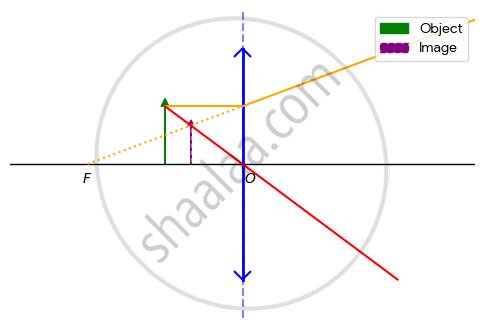
(c) (i) Given: f1 = +30 cm
f2 = −15 cm (Concave)
By using the formula:
`1/F = 1/f_1 + 1/f_2`
= `1/30 + 1/-15`
= `(1 - 2)/30`
`1/F = -1/30`
F = −30 cm
= −0.3 m
By using the formula for power:
P = P1 + P2
= `1/F`
= `1/-0.3`
= −3.33 D
∴ The equivalent focal length is −30 cm, and the power is −3.33 Dioptres.
OR
(c) (ii) Given: `f_"concave"` = −2 m
⇒ P1 = `1/-2`
= −0.5 D
`f_"convex"` = +1.5 m
⇒ P2 = `1/1.5`
= +0.67 D
Combined Power:
P = P1 + P2
= −0.5 + 0.67
= +0.17 D
∴ The combination behaves as a convex lens because the power of the convex lens is greater than the power of the concave lens, resulting in a positive net power.
