Advertisements
Advertisements
प्रश्न
Define the terms : Input resistance How are these determined using typical input and output characteristics?
Advertisements
उत्तर
Input resistance may be defined as the ratio of small change in the base-emitter voltage (ΔVBE) to the resulting change in base current (IB) at constant collector-emitter voltage (VCE).
Input resistance, `R_i=(DeltaV_(BE))/(DeltaI_B)`
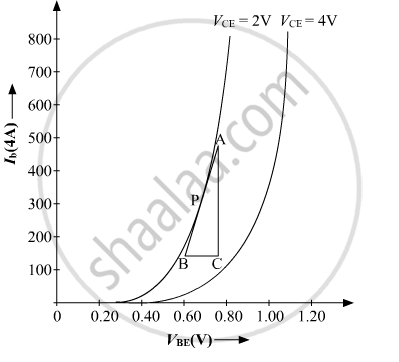
To find the input resistance, mark a point P on the input characteristic. Now, draw a tangent at point P. The reciprocal of slope of AB will give the input resistance
APPEARS IN
संबंधित प्रश्न
Write the functions of three segments of a transistor.
With the help of necessary circuit diagram, describe briefly how n-p-n transistor in CE configuration amplifies a small sinusoidal input voltage. Write the expression for the ac current gain
Under what condition does the transistor act as an amplifier?
Derive an expression for voltage gain of the amplifier and hence show that the output voltage is in opposite phase with the input voltage.
Draw a circuit diagram for studying the input and output characteristics of a n-p-n transistor in common emitter configuration. Using the circuit, explain how input, output characteristics are obtained
Draw a labelled diagram of a common emitter amplifier, showing waveforms of the signal voltage and output voltage.
Figure shows a block diagram of a transmitter identify the boxes ‘X’ and ‘Y’ and write their functions.

Figure shows a block diagram of a detector for amplitude modulated signal. Identify the boxes ‘X’ and ‘Y’ and write their functions.

Write the truth table of the following circuit. Name the gate represented by this circuit.

A pnp transistor is used in common-emitter mode in an amplifier circuit. A change of 40 µA in the base current brings a change of 2 mA in collector current and 0.04 V in base emitter voltage. Which of the following is the correct value of the input resistor Rin?
