Advertisements
Advertisements
प्रश्न
In triangles ABC and PQR, ∠A = ∠Q and ∠B = ∠R. Which side of ∆PQR should be equal to side BC of ∆ABC so that the two triangles are congruent? Give reason for your answer.
Advertisements
उत्तर
Given: In triangle ABC and PQR,
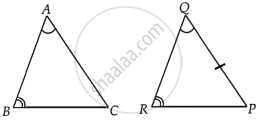
∠A = ∠Q and ∠B = ∠R ...[Given]
BC = RP ...[For the triangle to be congruent]
Hence, it will be congruent by AAS congruent rule.
APPEARS IN
संबंधित प्रश्न
If ΔABC ≅ ΔABC is isosceles with
In ΔPQR ≅ ΔEFD then ED =
In an isosceles triangle, if the vertex angle is twice the sum of the base angles, then the measure of vertex angle of the triangle is
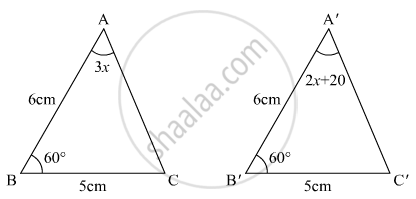
In the given figure, the measure of ∠B'A'C' is
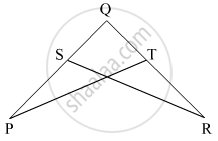
In the given figure, ∠P ≅ ∠R seg, PQ ≅ seg RQ. Prove that, ΔPQT ≅ ΔRQS.
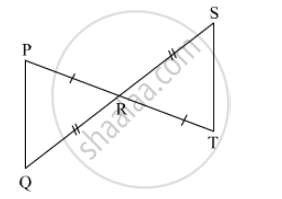
In the pair of triangles given below, the parts shown by identical marks are congruent. State the test and the one-to-one correspondence of vertices by which the triangles in the pair are congruent, the remaining congruent parts.
In the figure, BC = CE and ∠1 = ∠2. Prove that ΔGCB ≅ ΔDCE.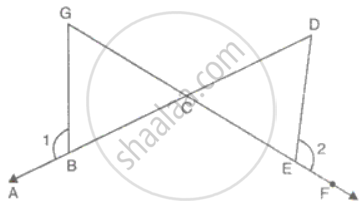
ΔABC is isosceles with AB = AC. BD and CE are two medians of the triangle. Prove that BD = CE.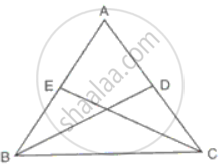
Given that ∆ABC ≅ ∆DEF List all the corresponding congruent sides
Without drawing the triangles write all six pairs of equal measures in the following pairs of congruent triangles.
∆YZX ≅ ∆PQR
