Advertisements
Advertisements
प्रश्न
In the given figure, seg PS is the median of ∆PQR and PT ⊥ QR. Prove that,
PR2 = PS2 + QR × ST + `("QR"/2)^2`

Advertisements
उत्तर
Seg PS is the median of ∆PQR ...(Given)
∴ QS = SR = `1/2`QR ...(1) [S is the midpoint of side QR]
In ∆PTS, ∠PTS = 90° ...(Given)
∴ by Pythagoras theorem,
PS2 = PT2 + TS2 ...(2)
In ∆PTR, ∠PTR = 90° ...(Given)
∴ by Pythagoras theorem,
PR2 = PT2 + TR2
∴ PR2 = PT2 + (TS + SR)2 ...(T-S-R)
∴ PR2 = PT2 + TS2 + 2ST2.SR + SR2 ...[(a + b)2 = a2 + 2ab + b2]
∴ PR2 = (PT2 + TS2) + 2ST.SR + SR2
∴ PR2 = PS2 + 2ST.`(("QR")/2) + (("QR")/2)^2` ...[From (1) and (2)]
∴ PR2 = PS2 + QR × ST + `(("QR")/2)^2`
APPEARS IN
संबंधित प्रश्न
Adjacent sides of a parallelogram are 11 cm and 17 cm. If the length of one of its diagonal is 26 cm, find the length of the other.
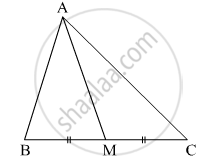
In ∆ABC, point M is the midpoint of side BC. If, AB2 + AC2 = 290 cm2, AM = 8 cm, find BC.
Find the perimeter of a square if its diagonal is `10sqrt2` cm:
Height and base of a right angled triangle are 24 cm and 18 cm find the length of its hypotenuse
A side of an isosceles right angled triangle is x. Find its hypotenuse.
Seg PM is a median of ∆PQR. If PQ = 40, PR = 42 and PM = 29, find QR.
Seg AM is a median of ∆ABC. If AB = 22, AC = 34, BC = 24, find AM
If hypotenuse of a right angled triangle is 5 cm, find the radius of
the circle passing through all vertices of the triangle.
Choose the correct alternative:
Out of the following which is a Pythagorean triplet?
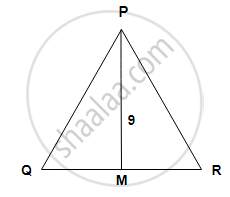
In ΔPQR, seg PM is a median, PM = 9 and PQ2 + PR2 = 290. Find the length of QR.
In ΔPQR, seg PM is the median. If PM = 9, PQ2 + PR2 = 290, Find QR.
In ΔABC, seg AP is a median. If BC = 18, AB2 + AC2 = 260, then find the length of AP.
Out of given triplets, which is not a Pythagoras triplet?
Out of all numbers from given dates, which is a Pythagoras triplet?
Which of the following figure is formed by joining the mid-points of the adjacent sides of a square?
In the given figure, triangle ABC is a right-angled at B. D is the mid-point of side BC. Prove that AC2 = 4AD2 – 3AB2.

