Advertisements
Advertisements
प्रश्न
In the given figure, ΔBCD is isosceles with base BD and ∠BAE ≡∠DEA. Prove that AB ≡ ED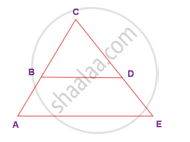
Advertisements
उत्तर
| Statements | Reasons |
| 1. ∠BAE ≡ ∠DEA | Given |
| 2. AC = EC | By (1) sides opposite to equal angles are equal |
| 3. BC = DC | Given BCD is isosceles with base BD |
| 4. AC – BC = EC – DC | 2 – 3 |
| 5. AB ≡ ED | By 4 |
APPEARS IN
संबंधित प्रश्न
Given below are measurements of some parts of two triangles. Examine whether the two triangles are congruent or not, by using the SAS congruence rule. If the triangles are congruent, write them in symbolic form.
∆ABC, AB = 7 cm, BC = 5 cm, ∠B = 50°.
∆DEF, DE = 5 cm, EF = 7 cm, ∠E = 50°.
Given below are measurements of some parts of two triangles. Examine whether the two triangles are congruent or not, by using the SAS congruence rule. If the triangles are congruent, write them in symbolic form.
∆ABC, AB = 4.5 cm, AC = 4 cm, ∠A = 60°.
∆DEF, DE = 4 cm, FD = 4.5 cm, ∠D = 55°.
For the given pair of triangles state the criterion that can be used to determine the congruency?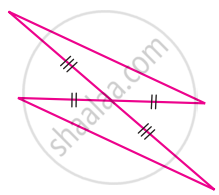
Construct a triangle XYZ with the given conditions.
BC = 8 cm, AC = 6 cm and ∠C = 40°
Construct a triangle PQR with given conditions.
∠P = 115°, ∠Q = 40° and PQ = 6 cm
In ∆ABC and ∆PQR, ∠A = 50° = ∠P, PQ = AB, and PR = AC. By which property ∆ABC and ∆PQR are congruent?
In the following figure, M is the mid-point of both AC and BD. Then ______.
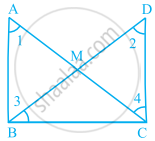
In the following figure, which pairs of triangles are congruent by SAS congruence criterion (condition)? if congruent, write the congruence of the two triangles in symbolic form.

State which of the following pairs of triangles are congruent. If yes, write them in symbolic form (you may draw a rough figure).
∆PQR: PQ = 3.5 cm, QR = 4.0 cm, ∠Q = 60°
∆STU: ST = 3.5 cm, TU = 4 cm, ∠T = 60°
State which of the following pairs of triangles are congruent. If yes, write them in symbolic form (you may draw a rough figure).
∆ABC: AB = 4.8 cm, ∠A = 90°, AC = 6.8 cm
∆XYZ: YZ = 6.8 cm, ∠X = 90°, ZX = 4.8 cm
