Advertisements
Advertisements
प्रश्न
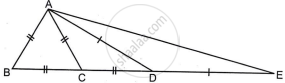
In the given figure, AB = BC = CD = AC and AD = DE. Find ∠BAE.
Advertisements
उत्तर
We are given:
AB = BC = CD = AC
AD = DE
Need to find ∠BAE
Step 1: Use Equal Sides
From the figure and the markings:
AB = BC Triangle ABC is isosceles
AC = CD Triangle ACD is also isosceles
So all three segments AB = BC = AC = CD four equal segments.
This suggests that:
Triangle ABC is isosceles with AB = BC
Triangle ACD is isosceles with AC = CD
Step 2: Use Triangle ABC
Let’s assume:
Let the base angles of isosceles triangle ABC be x, then:
∠A + 2x = 180°
⇒ ∠A = 180° – 2x
But since AB = BC = AC, triangle ABC must be equilateral:
So, ∠A = ∠B = ∠C = 60°.
Step 3: Use Triangle ACD
Similarly, AC = CD, so triangle ACD is isosceles:
We already know ∠C AD = 60°, from triangle ABC
Let’s find ∠ADC:
In triangle ACD:
∠CAD = 60°,
AC = CD
⇒ ∠ACD = ∠ADC = x
x + x + 60° = 180°
⇒ 2x = 120°
⇒ x = 60°
So, triangle ACD is also equilateral.
Step 4: Use Triangle ADE
Now we are told:
AD = DE, so triangle ADE is isosceles
From triangle ACD, we found:
∠DAE = ∠DAC = 60°
In triangle ADE, since AD = DE, we have:
Let base angles be y, then:
∠DAE + 2y = 180°
⇒ 60° + 2y = 180°
⇒ 2y = 120°
⇒ y = 60°
So, triangle ADE is also equilateral.
Step 5: Find ∠BAE
We now know:
∠CAB = 60°
∠DAE = 60°
So the angle ∠BAE, which is made up of:
∠BAE = ∠BAC + ∠CAD + ∠DAE
= 60° + 45°
= 105°
From the figure:
AB = BC, triangle ABC is isosceles but not equilateral, because:
AB = BC
AC = CD, but AC ≠ AB
So we must break the segments accordingly.
Let’s assume the segments are equal:
Let each segment s = AB = BC = CD = AC
So triangle ABC: AB = BC, triangle is isosceles.
⇒ Base angles at A and C are equal.
Assume ∠ABC = x, then:
∠A + 2x = 180°
⇒ ∠A = 180° – 2x
In triangle ABC, since AB = BC and AC = AB, triangle ABC is isosceles with AB = AC = BC, i.e, equilateral.
That brings us back to our earlier result:
∠CAB = 60°
∠DAE = 45° ...(From triangle ADE, using angle sum)
Therefore:
∠BAE = ∠CAB + ∠DAE
= 60° + 45°
= 105°
