Advertisements
Advertisements
प्रश्न
In the following, trigonometric ratios is given. Find the value of the other trigonometric ratios.
`sin A = 2/3`
Advertisements
उत्तर १
We know that `sin theta = "opposite side"/"hypotenuse"`
Let us Consider a right-angled ΔABC
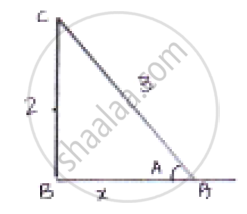
By applying Pythagorean theorem we get
𝐴𝐶2 = 𝐴𝐵2 + 𝐵𝐶2
`9 = x^2 + 4`
`x = sqrt5`
We know that = `cos = "adjacent side"/"hypotenuse"` and
`tan theta = "opposite side"/"adjacent side"`
So `cos theta = sqrt5/3`
`sec = 1/cos theta = 3/sqrt5`
`tan theta = 2/sqrt5`
`cot = 1/tan theta = sqrt5/2`
`cosec theta = 1/ sin theta = 3/2`
उत्तर २
Given: `sin A=2/3`……(1)
By definition
`sin A= "Perpendicular"/"Hypotenuse"` …... (2)
By comparing (1) and (2)
We get,
Perpendicular side = 2 and
Hypotenuse = 3
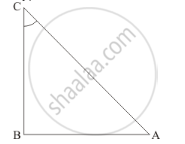
Therefore, by Pythagoras theorem,
`AC^2=AB^2+BC^2`
Now we substitute the value of perpendicular side (BC) and hypotenuse (AC) and get the base side (AB)
Therefore,
`3^2=AB^2+2^2`
`AB^2=3^2-2^2`
`AB^2=9-4`
`AB^2=5`
`AB=sqrt5`
Hence, Base = `sqrt5`
Now, `cos A=" Base"/ "Hypotenuse"`
cos A = `sqrt 5/3`
Now, `sec A = "Hypotenuse"/"Perpendicluar"`
Therefore,
`"cosec" A= "Hypotenuse"/"Perpendicular"`
`"cosec" A=3/2`
Now, `tan A="Perpendicular"/"Base"`
Therefore,
`sec A=3/sqrt5`
Now, `tan A "Perpendicular"/"Base"`
Therefore,
`tan A= 2/sqrt5`
Now, `cos A= "Base"/"Perendicluar"`
Therefore,
`cot A= sqrt 5/2`
APPEARS IN
संबंधित प्रश्न
In ΔABC right angled at B, AB = 24 cm, BC = 7 m. Determine:
sin C, cos C
State whether the following are true or false. Justify your answer.
cos A is the abbreviation used for the cosecant of angle A.
In the following, trigonometric ratios is given. Find the value of the other trigonometric ratios.
`cos A = 4/5`
In the following, one of the six trigonometric ratios is given. Find the values of the other trigonometric ratios.
`tan theta = 8/15`
If 3 cot θ = 2, find the value of `(4sin theta - 3 cos theta)/(2 sin theta + 6cos theta)`.
If `cos θ = 12/13`, show that `sin θ (1 - tan θ) = 35/156`.
if `sec A = 17/8` verify that `(3 - 4sin^2A)/(4 cos^2 A - 3) = (3 - tan^2 A)/(1 - 3 tan^2 A)`
If `sin theta = a/b` find sec θ + tan θ in terms of a and b.
If `tan θ = 20/21` show that `(1 - sin theta + cos theta)/(1 + sin theta + cos theta) = 3/7`
If Cosec A = 2 find `1/(tan A) + (sin A)/(1 + cos A)`
Evaluate the following:
sin 45° sin 30° + cos 45° cos 30°
Evaluate the following
tan2 30° + tan2 60° + tan2 45°
Evaluate the following:
(cosec2 45° sec2 30°)(sin2 30° + 4 cot2 45° − sec2 60°)
Evaluate the Following
4(sin4 30° + cos2 60°) − 3(cos2 45° − sin2 90°) − sin2 60°
Evaluate the Following:
`tan 45^@/(cosec 30^@) + sec 60^@/cot 45^@ - (5 sin 90^@)/(2 cos 0^@)`
5 tan² A – 5 sec² A + 1 is equal to ______.
The value of the expression `[(sin^2 22^circ + sin^2 68^circ)/(cos^2 22^circ + cos^2 68^circ) + sin^2 63^circ + cos 63^circ sin 27^circ]` is ______.
Prove the following:
If tan A = `3/4`, then sinA cosA = `12/25`
Find the value of sin 45° + cos 45° + tan 45°.
