Advertisements
Advertisements
प्रश्न
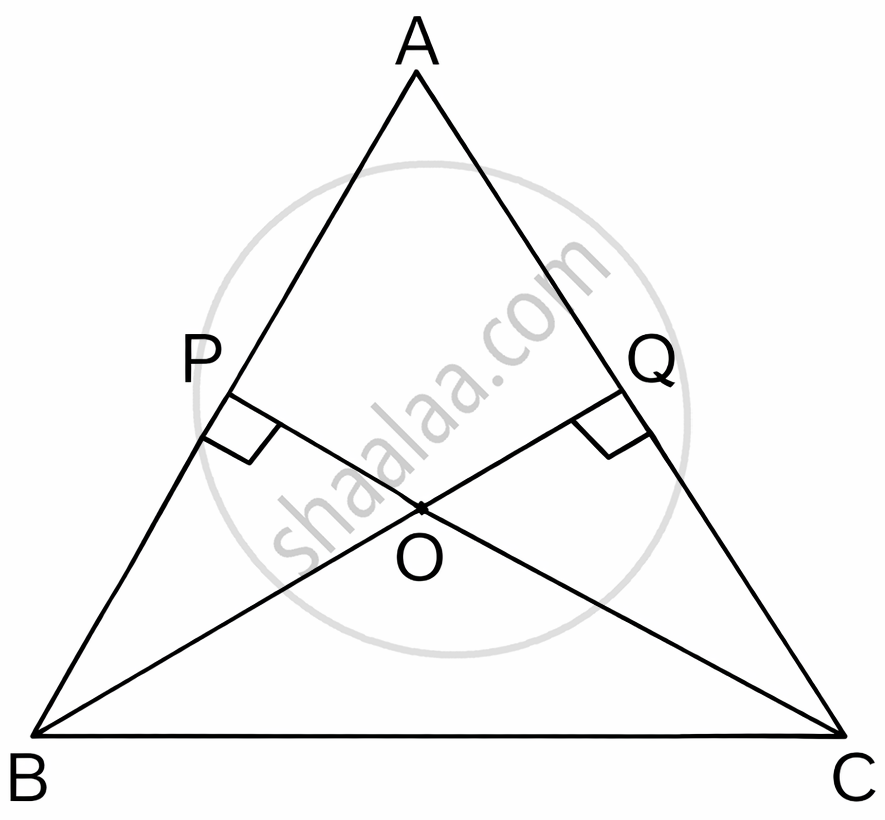
In the following figure, BQ and CP are the altitudes on AC and AB, respectively. Prove that:
- BP × OQ = CQ × OP
- ΔРОQ − ΔВОС
बेरीज
Advertisements
उत्तर
Given that BQ and CP are altitudes of △ABC.
So,
- BQ ⊥ AC, hence ∠BQC = 90°
- CP ⊥ AB, hence ∠BPC = 90°
Also, O is the intersection point of BQ and CP.
⇒ Consider triangles △BOP and △COQ.
We have:
- ∠BPO = 90° and ∠CQO = 90°
- ∠BOP = ∠COQ since they are vertically opposite angles
Therefore, △BOP ∼ △COQ by AA similarity.
Hence, corresponding sides are proportional:
`(BP)/(CQ) = (OP)/(OQ)`
Cross-multiplying,
BP × OQ = CQ × OP
Hence proved,
⇒ In triangles △POQ and △BOC,
`(OP)/(OQ) = (BP)/(CQ)`
Now consider triangles △BPC and △CQB.
Since,
- ∠BPC = 90°
- ∠CQB = 90°
- ∠PBC = ∠QCB because PB lies on BA and QC lies on CA
So, △BPC ∼ △CQB
Therefore, ∠BCP = ∠CBQ, which gives the angle relation needed below.
Now in △POQ and △BOC:
- ∠POQ = ∠BOC (vertically opposite angles)
- ∠PQO = ∠BCO, since PQ lies along a direction corresponding to BC from the altitude construction, and equivalently, one can obtain this from the similarity of the right triangles formed by the altitudes.
Thus, △POQ ∼ △BOC by AA similarity.
Hence proved.
shaalaa.com
या प्रश्नात किंवा उत्तरात काही त्रुटी आहे का?
