Advertisements
Advertisements
प्रश्न
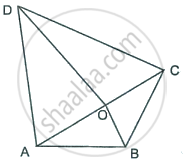
In the adjoining figure, O is the mid-point of diagonal AC of a quadrilateral ABCD. Prove that area (◻ABOD) = area (◻BODC).
Advertisements
उत्तर
Given: O is the midpoint of diagonal AC of quadrilateral ABCD, so AO = OC. Points A, O and C are collinear.
To Prove: Area (ABOD) = Area (BODC).
Proof [Step-wise]:
1. Split the quadrilaterals by the diagonals through O:
Quadrilateral ABOD = area (ΔAOB) + area (ΔAOD) split by AO.
Quadrilateral BODC = area (ΔBOC) + area (ΔCOD) split by OC.
2. Compare ΔAOB and ΔBOC:
Both triangles have the same vertex B and their bases AO and OC lie on the same line AC, so the perpendicular distance (height) from B to line AC is the same for both triangles.
Area (ΔAOB) = `1/2` × AO × height from B to AC.
And Area (ΔBOC) = `1/2` × OC × height from B to AC
Since AO = OC ...(O is midpoint of AC), area (ΔAOB) = area (ΔBOC)
3. Compare ΔAOD and ΔCOD similarly:
Both have vertex D and bases AO and OC on the same line AC, so the perpendicular distance from D to AC is the same for both.
Area (ΔAOD) = `1/2` × AO × height from D to AC.
And Area (ΔCOD) = `1/2` × OC × height from D to AC.
Again, AO = OC, so area (ΔAOD) = area (ΔCOD).
4. Add the equalities from steps 2 and 3:
Area (ΔAOB) + Area (ΔAOD) = Area (ΔBOC) + Area (ΔCOD).
5. Using step 1, the left side is area (ABOD) and the right side is area (BODC).
Therefore, area (ABOD) = area (BODC).
Hence proved.
