Advertisements
Advertisements
प्रश्न
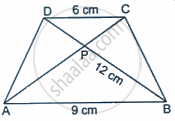
In the adjoining figure, ABCD is a trapezium in which DC is parallel to AB. If AB = 9 cm, DC = 6 cm and BD = 12 cm, find:
- BP
- the ratio of the areas of ΔAPB and ΔDPC
बेरीज
Advertisements
उत्तर
Given: In trapezium ABCD, DC || AB,
AB = 9 cm, DC = 6 cm, BD = 12 cm
Diagonals AC and BD intersect at P.
(i) Since AB || DC, the diagonals of a trapezium divide each other proportionally.
Therefore,
`(BP)/(PD) = (AB)/(DC) = 9/6 = 3/2`
So, BP : PD = 3 : 2
But, BD = BP + PD = 12 cm
Hence,
`BP = 3/(3 + 2) xx 12`
`BP = 3/5 xx 12`
`BP = 36/5`
∴ BP = 7.2 cm
(ii) In triangles △APB and △DPC,
- ∠APB = ∠DPC (vertically opposite angles)
- ∠ABP = ∠CDP (alternate interior angles, since AB || DC)
Therefore, △APB ∼ △DPC
Hence,
`(AB)/(DC) = (BP)/(PD) = (AP)/(PC) = 3/2`
Now, the ratio of areas of similar triangles is equal to the square of the ratio of their corresponding sides.
Therefore,
ar(△APB) : ar(△DPC) = `(3/2)^2 = 9/4`
∴ ar(△APB) : ar(△DPC) = 9 : 4
shaalaa.com
या प्रश्नात किंवा उत्तरात काही त्रुटी आहे का?
