Advertisements
Advertisements
प्रश्न
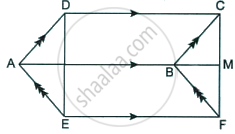
In the adjoining figure, ABCD and ABFE are two parallelograms.
Prove that: area (ABCD) + area (ABFE) = area (EFCD).
Advertisements
उत्तर
Given: ABCD and ABFE are parallelograms as shown.
To Prove: area (ABCD) + area (ABFE) = area (EFCD).
Proof [Step-wise]:
1. Choose coordinates (vector set-up).
Put A at the origin O.
Let AB = u. ...(a nonzero vector along the horizontal)
Let AD = p and AE = r.
Then points are:
B = A + u
D = A + p
E = A + r
C = B + p = A + u + p
F = B + r = A + u + r
2. Identify vectors for sides of parallelogram EFCD.
EF = F – E
= (A + u + r) – (A + r)
= u
FC = C – F
= (A + u + p) – (A + u + r)
= p – r
So, EFCD is a parallelogram with adjacent side vectors u and (p – r).
3. Express areas by the magnitude of the 2D cross product or base × height.
area (ABCD) = |u × p| ...(Parallelogram with adjacent sides u and p)
area (ABFE) = |u × r| ...(Parallelogram with adjacent sides u and r)
area (EFCD) = |u × (p – r)| = |u × p – u × r| ...(By bilinearity of the cross product).
4. Use the geometry of the picture:
ABCD and ABFE lie on opposite sides of AB.
So, the oriented scalar values u × p and u × r have opposite signs.
Therefore, u × p – u × r = (u × p) + |u × r| and taking absolute value gives |u × (p – r)| = |u × p| + |u × r|.
5. Substitute the area expressions from step 3:
area (EFCD) = |u × (p – r)|
= |u × p| + |u × r|
= area (ABCD) + area (ABFE).
