Advertisements
Advertisements
प्रश्न
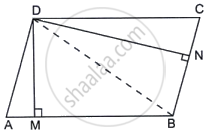
In the adjoining figure, a parallelogram ABCD is shown. If DM ⊥ AB, DN ⊥ BC, then area of ΔABD is equal to:
पर्याय
`1/2 xx AB xx DN`
`1/2 xx BC xx DN`
`1/2 xx BC xx DM`
`1/2 xx AD xx DM`
MCQ
Advertisements
उत्तर
`bb(1/2 xx BC xx DN)`
Explanation:
Diagonal BD splits parallelogram ABCD into two equal-area triangles.
So, area (△ABD) = area (△CBD).
In △CBD, the base is BC and the height from D to BC is DN (given DN ⟂ BC).
So, area = `1/2` × BC × DN.
shaalaa.com
या प्रश्नात किंवा उत्तरात काही त्रुटी आहे का?
