Advertisements
Advertisements
प्रश्न
In right triangle ABC, right angled at C, M is the mid-point of hypotenuse AB. C is joined to M and produced to a point D such that DM = CM. Point D is joined to point B (see the given figure). Show that:
- ΔAMC ≅ ΔBMD
- ∠DBC is a right angle.
- ΔDBC ≅ ΔACB
- CM = `1/2` AB

Advertisements
उत्तर
Since M is the mid-point of AB.
∴ BM = AM
i. In ΔAMC and ΔBMD, we have
CM = DM ...[Given]
∠AMC = ∠BMD ...[Vertically opposite angles]
AM = BM ...[Proved above]
∴ ΔAMC ≅ ΔBMD ...[By SAS congruency]
ii. Since ΔAMC ≅ ΔBMD
∠MAC = ∠MBD ...[By corresponding parts of congruent triangles]
But they form a pair of alternate interior angles.
∴ AC ‖ DB
Now, BC is a transversal which intersects parallel lines AC and DB,
∴ ∠BCA + ∠DBC = 180° ...[Co-interior angles]
But ∠BCA = 90° ...[ΔABC is right angled at C]
∴ 90° + ∠DBC = 180°
⇒ ∠DBC = 90°
iii. Again, ΔAMC ≅ ΔBMD ...[Proved above]
∴ AC = BD ...[By corresponding parts of congruent triangles]
Now, in ΔDBC and ΔACB, we have
BD = CA ...[Proved above]
∠DBC = ∠ACB ...[Each 90°]
BC = CB ...[Common]
∴ ΔDBC ≅ ΔACB ...[By SAS congruency]
iv. As ΔDBC ≅ ΔACB
⇒ DC = AB ...[By corresponding parts of congruent triangles]
But DM = CM ...[Given]
∴ CM = `1/2` DC = `1/2` AB
⇒ CM = `1/2` AB.
APPEARS IN
संबंधित प्रश्न
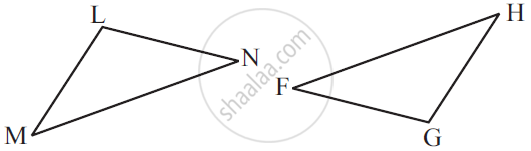
Which congruence criterion do you use in the following?
Given: ∠MLN = ∠FGH
∠NML = ∠GFH
ML = FG
So, ΔLMN ≅ ΔGFH
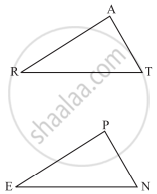
You want to show that ΔART ≅ ΔPEN,
If it is given that ∠T = ∠N and you are to use SAS criterion, you need to have
1) RT = and
2) PN =
In ΔABC, ∠A = 30°, ∠B = 40° and ∠C = 110°
In ΔPQR, ∠P = 30°, ∠Q = 40° and ∠R = 110°
A student says that ΔABC ≅ ΔPQR by AAA congruence criterion. Is he justified? Why or why not?
In a triangle ABC, D is mid-point of BC; AD is produced up to E so that DE = AD. Prove that:
AB = CE.
A triangle ABC has ∠B = ∠C.
Prove that: The perpendiculars from B and C to the opposite sides are equal.
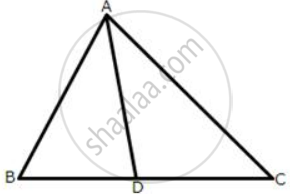
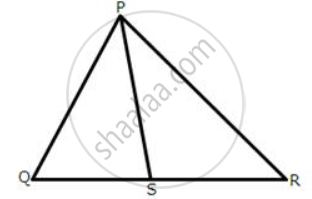
In the following figures, the sides AB and BC and the median AD of triangle ABC are equal to the sides PQ and QR and median PS of the triangle PQR.
Prove that ΔABC and ΔPQR are congruent.
 |
 |
ABCD is a parallelogram. The sides AB and AD are produced to E and F respectively, such produced to E and F respectively, such that AB = BE and AD = DF.
Prove that: ΔBEC ≅ ΔDCF.
In a ΔABC, BD is the median to the side AC, BD is produced to E such that BD = DE.
Prove that: AE is parallel to BC.
In quadrilateral ABCD, AD = BC and BD = CA.
Prove that:
(i) ∠ADB = ∠BCA
(ii) ∠DAB = ∠CBA
Which of the following is not a criterion for congruence of triangles?
