Advertisements
Advertisements
प्रश्न
In fig. XY is at right angles to the magnetic field. The direction in which XY should be moved to induce an electron flow in the direction Y to X as indicated by the arrow is:
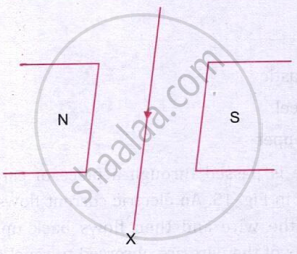
पर्याय
along the direction of XY.
towards N and perpendicular to XY.
towards S and perpendicular to XY.
upwards and perpendicular to XY.
Advertisements
उत्तर
upwards and perpendicular to XY.
Explanation:
According to Fleming’s right-hand rule, the conductor must move perpendicular to both the magnetic field and XY to induce electron flow from Y to X.
APPEARS IN
संबंधित प्रश्न
State the factors on which the strength of electric current flowing in a given conductor depends.
(a) With the help of a circuit diagram, obtain the relation for the equivalent resistance of two resistances connected in parallel.
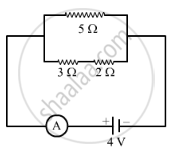
(b) In the circuit diagram shown below, find:
(i) Total resistance.
(ii) Current shown by the ammeter A
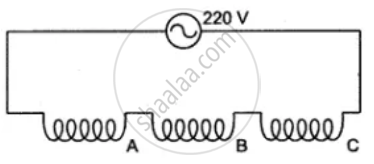
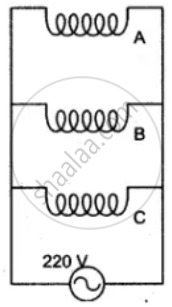
The diagram shows two ways of connecting three lamps P, Q and R to A.C. supply of 220 V.
A bulb marked 12 V, 24 W operates on a 12 V battery for 20 minutes. Calculate:
- The current flowing through it, and
- The energy consumed.
A current of 0.2 A flows through a wire whose ends are at a potential difference of 15 V. Calculate:
(i) The resistance of the wire, and
(ii) The heat energy produced in 1 minute.
An electric bulb is marked 100 W, 250 V. How much current will the bulb draw if connected to a 250 V supply?
The flow of electric charge per unit time is called potential difference.
What is the SI unit for the current?
