Advertisements
Advertisements
प्रश्न
In case of a parallelogram
prove that:
(i) The bisectors of any two adjacent angles intersect at 90o.
(ii) The bisectors of the opposite angles are parallel to each other.
Advertisements
उत्तर
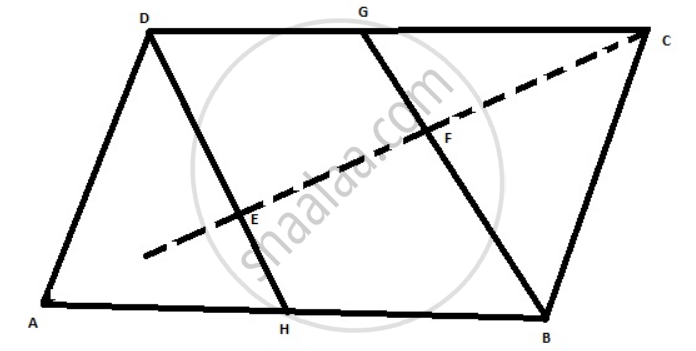
ABCD is a parallelogram, the bisectors of ∠ADC and ∠BCD meet at a point E and the bisectors of ∠BCD and ∠ABC meet at F.
We have to prove that the ∠CED = 90° and ∠CFG = 90°
Proof: In the parallelogram ABCD
∠ADC + ∠BCD = 180° ....[ sum of adjacent angles of a parallelogram ]
⇒ `"∠ADC"/2 + "∠BCD"/2` = 90°
⇒ ∠EDC + ∠ECD + ∠CED = 180°
⇒ ∠CED = 90°
Similarly taking triangle BCF it can be proved that ∠BFC = 90°
∠BFC + ∠CFG = 180° ....[ adjacent angles on a line ]
Also ⇒ ∠CFG = 90°
Now since ∠CFG = ∠CED = 90° ....[ It means that the lines DE and BG are parallel ]
Hence proved.
APPEARS IN
संबंधित प्रश्न
In a parallelogram `square`ABCD, If ∠A = (3x + 12)°, ∠B = (2x - 32)° then find the value of x and then find the measures of ∠C and ∠D.
In the following figures, find the remaining angles of the parallelogram
Find the measures of all the angles of the parallelogram shown in the figure:
In the given figure, ABCD is a parallelogram, find the values of x and y.
PQR is a triangle formed by the adjacent sides PQ and QR and diagonal PR of a parallelogram PQRS. If in ΔPQR, ∠P : ∠Q : ∠R = 3 : 8 : 4, Calculate the measures of all the angles of parallelogram PQRS.

Opposite angles of a quadrilateral ABCD are equal. If AB = 4 cm, determine CD.
If PQRS is a parallelogram, then ∠P – ∠R is equal to ______.
The sum of adjacent angles of a parallelogram is ______.
