Advertisements
Advertisements
प्रश्न
In an exhibition hall, there are 24 display boards each of length 1 m 50 cm and breadth 1 m. There is a 100 m long aluminium strip, which is used to frame these boards. How many square metres of cloth is required to cover all the display boards? What will be the length in m of the cloth used, if its breadth is 120 cm?
Advertisements
उत्तर
Given, total display boards = 24
Length of display board = 1 m + 50 cm
= 1 m + `50/100` m ...[∵ 1 m = 100 cm]
= 1 m + `1/2` m
= `((2 + 1)/2)` m
= `3/2` m
Breadth of display board = 1 m
Now, area of one display board = Length × Breadth
= `1 xx 3/2`
= `3/2` sq.m
∴ Area of 24 display boards = 24 × Area of one board
= `24 xx 3/2`
= 36 sq.m
Hence, 36 sq.m cloth is required to cover all the display boards.
Now, breadth = 120 cm ...[Given]
∵ 1 cm = 100 cm
∴ 1 cm = `1/100` m
⇒ 120 cm = `120/100 = 6/5` m
Let length = `l` m
∵ Area of display board = Length × Breadth
`36 = l xx 6/5`
⇒ `(36 xx 5)/6 = l xx 6/5 xx 5/6` ...[Multiply both sides by `6/5`]
⇒ `l` = 30 m
APPEARS IN
संबंधित प्रश्न
The diagonal of a square is 12 cm long; find its area and length of one side.
The area of a square is 169 cm2. Find its:
(i) one side
(ii) perimeter
The perimeter of a square is numerically equal to its area. Find its area.
Each side of a square is 7 m long. Find its perimeter

Measure the side of the red square on the dotted sheet. Draw here as many rectangles as possible using 12 such squares.
How many rectangles could you make?
1 m = ______ cm.
1 sq m = ______ sq cm.
Avneet buys 9 square paving slabs, each with a side of `1/2` m. He lays them in the form of a square.
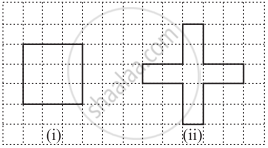
- What is the perimeter of his arrangement [Fig (i)]?
- Shari does not like his arrangement. She gets him to lay them out like a cross. What is the perimeter of her arrangement [(Fig (ii)]?
- Which has greater perimeter?
- Avneet wonders if there is a way of getting an even greater perimeter. Can you find a way of doing this? (The paving slabs must meet along complete edges i.e. they cannot be broken.)
If each side of a rhombus is doubled, how much will its area increase?
Three squares are attached to each other as shown in the following figure. Each square is attached at the mid-point of the side of the square to its right. Find the perimeter of the complete figure.

