Advertisements
Advertisements
प्रश्न
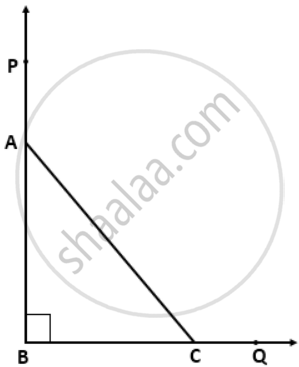
In a right-angled triangle ABC, ∠B = 90°. If BA and BC produced to the points P and Q respectively, find the value of ∠PAC + ∠QCA.
Advertisements
उत्तर

In ΔABC, ∠B = 90°
And, ∠ABC + ∠BAC + ∠ACB = 180°
⇒ ∠BAC + ∠ACB = 180° - ∠ABC
⇒ ∠BAC + ∠ACB = 180° - 90°
⇒ ∠BAC + ∠ACB = 90° ....(i)
By exterior angle property,
∠PAC = ∠ABC + ∠ACB ....(ii)
∠QCA = ∠ABC + ∠BAC ....(iii)
Adding (ii) and (iii), we get
∠PAC + ∠QCA = ∠ABC + ∠ACB + ∠ABC + ∠BAC
⇒ ∠PAC + ∠QCA = (∠ABC + ∠BAC) + 2∠ABC
⇒ ∠PAC + ∠QCA = 90° + 2 x 90° ....[From (i)]
⇒ ∠PAC + ∠QCA = 90° + 180°
⇒ ∠PAC + ∠QCA = 270°.
APPEARS IN
संबंधित प्रश्न
In the given figure, ∠Q: ∠R = 1: 2. Find:
a. ∠Q
b. ∠R
The exterior angles, obtained on producing the side of a triangle both ways, are 100° and 120°. Find all the angles of the triangle.
Use the given figure to find the value of x in terms of y. Calculate x, if y = 15°.
The angles of a triangle are (x + 10)°, (x + 30)° and (x - 10)°. Find the value of 'x'. Also, find the measure of each angle of the triangle.
In the figure given below, if RS is parallel to PQ, then find the value of ∠y.
In a triangle PQR, the internal bisectors of angles Q and R meet at A and the external bisectors of the angles Q and R meet at B. Prove that: ∠QAR + ∠QBR = 180°.
Use the given figure to show that: ∠p + ∠q + ∠r = 360°.
If bisectors of angles A and D of a quadrilateral ABCD meet at 0, then show that ∠B + ∠C = 2 ∠AOD
If each angle of a triangle is less than the sum of the other two angles of it; prove that the triangle is acute-angled.
If the angles of a triangle are in the ratio 2: 4: 6; show that the triangle is a right-angled triangle.