Advertisements
Advertisements
प्रश्न
If we pure-bred tall (dominant) pea plant with pure-bred dwarf (recessive) pea plant we will get pea plants of F1 generation. If we now self-cross the pea plant of F1 generation, then we obtain pea plants of F2 generation.
(a) What do the plants of F2 generation look like?
(b) State the ratio of tall plants to dwarf plants in F2 generation.
(c) State the type of plants not found in F1 generation but appeared in F2 generation, mentioning the reason for the same.
Advertisements
उत्तर
When a pure breeding tall pea plant is crossed with a pure breeding dwarf pea plant
(a) All the plants in the F1 generation appear tall.
(b) The ratio of tall pea plant to dwarf pea plants is 3 (tall) : 1 (dwarf).
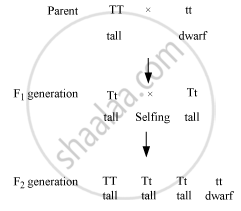
(c) The dwarf plant does not appear in the F1 generation but appears in the F2 generation because the progeny produced in the F1generation were heterozygous (Tt). Hence, when they were selfed for obtaining the F2 generation, dwarf plants were also formed in the progeny. The cross involved in as follows
संबंधित प्रश्न
"A trait may be inherited, but may not be expressed." Justify this statement with the help of a suitable example.
How is the equal genetic contribution of male and female parents ensured in the progeny?
A man having blood group O marries a woman having blood group B and they have a daughter. What will be the blood group of the daughter?
Pure-bred tall pea plants are first crossed with pure-bred dwarf pea plants. The pea plants obtained in F1generation are then cross-bred to produce F2 generation of pea plants.
(a) What do the plants of F1 generation look like?
(b) What is the ratio of tall plants to dwarf plants in F2 generation?
(c) Which type of plants were missing in F1 generation but reappeared in F2 generation?
A person first crossed pure-bred pea plants having round-yellow seeds with pure-bred pea plants having wrinkled-green seeds and found that only A-B type of seeds were produced in the F1 generation. When F1generation pea plants having A-B type of seeds were cross-bred by self-pollination, then in addition to the original round-yellow and wrinkled-green seeds, two new varieties A-D and C-B type of seeds were also obtained.
(a) What are A-B type of seeds?
(b) State whether A and B are dominant traits or recessive traits.
(c) What are A-D type of seeds?
(d) What are C-B type of seeds?
(c) Out of A-B and A-D types of seeds, which one will be produced in (i) minimum numbers, and (ii) maximum numbers, in the F2 generation?
The term 'father of genetics' is used for the scientist :
(a) Morgan
(b) Mendel
(c) Darwin
(d) Marie Curie
List two differences in tabular form between dominant trait and recessive traits. What percentage/proportion of the plants in the F2 generation/progeny were round, in Mendel's cross between round and wrinkled pea plants?
"It is possible that a trait is inherited but may not be expressed." Give a suitable example to justify this statement.
In humans, if gene B gives brown eyes and gene b gives blue eyes, what will be the colour of eyes of the persons having combinations
(i) Bb and (ii) BB?
If a tall pea plant is crossed with a pure dwarf pea plant then, what percentage of F1 and F2 generation respectively will be tall?
