Advertisements
Advertisements
प्रश्न
If the lines 3x – 4y + 4 = 0 and 6x – 8y – 7 = 0 are tangents to a circle, then find the radius of the circle.
Advertisements
उत्तर
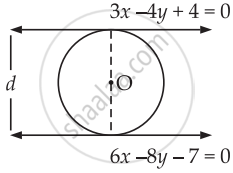
Given equation are 3x – 4y + 4 = 0
And 6x – 8y – 7 = 0
⇒ `3x - 4y - 7/2` = 0
Since `3/6 = (-4)/(-8) = 1/2` then the lines are parallel.
So, the distance between the parallel lines
= `|(c_1 - c_2)/sqrt(a^2 + b^2)|`
= `|(4 + 7/2)/sqrt((3)^2 + (-4)^2)|`
= `|(15/2)/5|`
= `3/2`
Diameter = `3/2`
∴ Radius = `3/4`.
APPEARS IN
संबंधित प्रश्न
Find the coordinates of the foci, the vertices, the length of major axis, the minor axis, the eccentricity and the length of the latus rectum of the ellipse.
`x^2/36 + y^2/16 = 1`
Find the coordinates of the foci, the vertices, the length of major axis, the minor axis, the eccentricity and the length of the latus rectum of the ellipse.
`x^2/4 + y^2/25 = 1`
Find the coordinates of the foci, the vertices, the length of major axis, the minor axis, the eccentricity and the length of the latus rectum of the ellipse.
`x^2/16 + y^2/9 = 1`
Find the coordinates of the foci, the vertices, the length of major axis, the minor axis, the eccentricity and the length of the latus rectum of the ellipse.
`x^2/49 + y^2/36 = 1`
Find the coordinates of the foci, the vertices, the length of major axis, the minor axis, the eccentricity and the length of the latus rectum of the ellipse.
16x2 + y2 = 16
Find the coordinates of the foci, the vertices, the length of major axis, the minor axis, the eccentricity and the length of the latus rectum of the ellipse.
4x2 + 9y2 = 36
A rod of length 12 cm moves with its ends always touching the coordinate axes. Determine the equation of the locus of a point P on the rod, which is 3 cm from the end in contact with the x-axis.
Find the vertex, focus, axis, directrix and latus-rectum of the following parabola:
y2 = 8x
Find the vertex, focus, axis, directrix and latus-rectum of the following parabola
y2 + 4x + 4y − 3 = 0
Find the vertex, focus, axis, directrix and latus-rectum of the following parabola
y2 = 8x + 8y
Find the vertex, focus, axis, directrix and latus-rectum of the following parabola
x2 + y = 6x − 14
For the parabola y2 = 4px find the extremities of a double ordinate of length 8 p. Prove that the lines from the vertex to its extremities are at right angles.
Find the length of the line segment joining the vertex of the parabola y2 = 4ax and a point on the parabola where the line-segment makes an angle θ to the x-axis.
Write the axis of symmetry of the parabola y2 = x.
Write the distance between the vertex and focus of the parabola y2 + 6y + 2x + 5 = 0.
If the coordinates of the vertex and focus of a parabola are (−1, 1) and (2, 3) respectively, then write the equation of its directrix.
In the parabola y2 = 4ax, the length of the chord passing through the vertex and inclined to the axis at π/4 is
The vertex of the parabola (y − 2)2 = 16 (x − 1) is
Find the centre, the lengths of the axes, eccentricity, foci of the following ellipse:
x2 + 2y2 − 2x + 12y + 10 = 0
Find the centre, the lengths of the axes, eccentricity, foci of the following ellipse:
x2 + 4y2 − 4x + 24y + 31 = 0
Find the centre, the lengths of the axes, eccentricity, foci of the following ellipse:
3x2 + 4y2 − 12x − 8y + 4 = 0
Find the centre, the lengths of the axes, eccentricity, foci of the following ellipse:
4x2 + 16y2 − 24x − 32y − 12 = 0
Find the centre, the lengths of the axes, eccentricity, foci of the following ellipse:
x2 + 4y2 − 2x = 0
A rod of length 12 m moves with its ends always touching the coordinate axes. Determine the equation of the locus of a point P on the rod, which is 3 cm from the end in contact with x-axis.
Find the equation of the set of all points whose distances from (0, 4) are\[\frac{2}{3}\] of their distances from the line y = 9.
If the lengths of semi-major and semi-minor axes of an ellipse are 2 and \[\sqrt{3}\] and their corresponding equations are y − 5 = 0 and x + 3 = 0, then write the equation of the ellipse.
Write the eccentricity of the ellipse 9x2 + 5y2 − 18x − 2y − 16 = 0.
Find the equation of the ellipse with foci at (± 5, 0) and x = `36/5` as one of the directrices.
The equation of the circle having centre (1, –2) and passing through the point of intersection of the lines 3x + y = 14 and 2x + 5y = 18 is ______.
The equation of the ellipse whose centre is at the origin and the x-axis, the major axis, which passes through the points (–3, 1) and (2, –2) is ______.
Find the equation of a circle which touches both the axes and the line 3x – 4y + 8 = 0 and lies in the third quadrant.
The shortest distance from the point (2, –7) to the circle x2 + y2 – 14x – 10y – 151 = 0 is equal to 5.
