Advertisements
Advertisements
प्रश्न
If the sum of the two angles of a quadrilateral is 180°. What is the sum of the remaining two angles?
Advertisements
उत्तर
\[\text{ Let } \left( x + y \right) \text{ be the sum of the remaining two angles .} \]
\[\text{ Since, the sum of all the angles of a quadrilateral is } 360°, \text{ we have } : \]
\[180° + \left( x + y \right)° = 360°\]
\[ \Rightarrow \left( x + y \right)° = 180° \]
\[ \therefore \text{ The sum of the remaining two angles is } 180° .\]
संबंधित प्रश्न
Three angles of a quadrilateral are equal. Fourth angle is of measure 150°. What is the measure of equal angles.
The four angles of a quadrilateral are as 3 : 5 : 7 : 9. Find the angles.
Given : In quadrilateral ABCD ; ∠C = 64°, ∠D = ∠C – 8° ; ∠A = 5(a+2)° and ∠B = 2(2a+7)°.
Calculate ∠A.
In a trapezium ABCD, side AB is parallel to side DC. If ∠A = 78° and ∠C = 120. find angles B and D.
The angles A, B, C and D of a trapezium ABCD are in the ratio 3: 4: 5: 6. Le. ∠A : ∠B : ∠C : ∠D = 3:4: 5 : 6. Find all the angles of the trapezium. Also, name the two sides of this trapezium which are parallel to each other. Give reason for your answer.
In the figure, PQRS and PTVS are two cyclic quadrilaterals, If ∠QRS = 100°, then ∠TVS =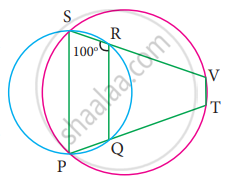
If one angle of a cyclic quadrilateral is 75°, then the opposite angle is
In quadrilateral ROPE, the pairs of adjacent angles are ______.
In the following figure, if point A is shifted to point B along the ray PX such that PB = 2PA, then the measure of ∠BPY is ______.

How many diagonals does a quadrilateral have?
