Advertisements
Advertisements
प्रश्न
If q is the mean proportional between p and r, prove that
`p^2 - q^2 + r^2 = q^4[(1)/p^2 - (1)/q^2 + (1)/r^2]`.
Advertisements
उत्तर
Since, q is the mean proportional of p and r.
Hence, q2 = pr.
R.H.S. = `q^4[(1)/p^2 - (1)/q^2 + (1)/r^2]`
= `q^4[(1)/p^2 - (1)/(pr) + (1)/r^2]`
= `q^4[(r^2 - pr + p^2)/(p^2r^2)]`
= `q^4[(p^2 - pr + r^2)/(pr)^2]`
= `q^4[(p^2 - pr + r^2)/q^4]`
= p2 - pr + r2
= p2 - q2 + r2 = L.H.S.
Hence proved.
संबंधित प्रश्न
If b is the mean proportion between a and c, show that: `(a^4 + a^2b^2 + b^4)/(b^4 + b^2c^2 + c^4) = a^2/c^2`.
Find the third proportional to a – b and a2 – b2
Find the fourth proportion to the following:
3,5 and 15
If a, b, c, d are in continued proportion, prove that (b − c)2 + (c − a)2 + (d − b)2 = (d − a)2.
A transport company charges Rs 540 to carry 25 tonnes of weight. What will it charge to carry 35 tonnes?
A given quantity of rice is sufficient for 60 persons for 3 days. How many days would the rice last for 18 persons?
If `x/a = y/b = z/c`, prove that `x^3/a^2 + y^3/b^2 + z^3/c^2 = (x+ y+ z)^3/(a + b+ c)^2`
If 2, 6, p, 54 and q are in continued proportion, find the values of p and q.
Determine if the following ratios form a proportion. Also, write the middle terms and extreme terms where the ratios form a proportion.
200 mL : 2.5 litre and ₹ 4 : ₹ 50
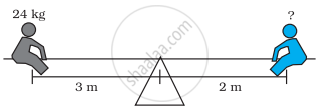
Unequal masses will not balance on a fulcrum if they are at equal distance from it; one side will go up and the other side will go down.
Unequal masses will balance when the following proportion is true:
`("mass"1)/("length"2) = ("mass"2)/("length"1)`

Two children can be balanced on a seesaw when
`("mass"1)/("length"2) = ("mass"2)/("length"1)`. The child on the left and child on the right are balanced. What is the mass of the child on the right?