Advertisements
Advertisements
प्रश्न
If in two circles, arcs of the same length subtend angles 60° and 75° at the centre, find the ratio of their radii.
Advertisements
उत्तर
Let r1, r2 and 01, 02 be the radii and angles subtended at the centre of two circles, respectively.
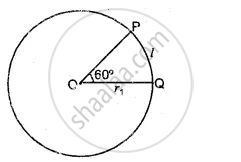
Let its radius = r1
l = r1θ1
= r1 `pi/3`
∴ r1 = `(3l)/pi` …(i)
For the second circle,
Let radius = r2
Arc length = l
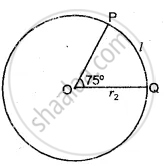
The angle made by the arc at the centre, θ2 = 75°
= `75 xx π/180` radians
= `(5π)/12` radians
r2 = `(12l)/(5π)`
On dividing equation (i) by equation (ii)
`r^1/r^2 = (3l)/π + (12l)/(5π)`
= `(3l)/πxx(5π)/(12l)` = 5 : 4.
APPEARS IN
संबंधित प्रश्न
Find the radian measure corresponding to the following degree measure:
25°
A wheel makes 360 revolutions in one minute. Through how many radians does it turn in one second?
Find the angle in radian through which a pendulum swings if its length is 75 cm and the tip describes an arc of length
10 cm
Find the degree measure corresponding to the following radian measure:
\[\frac{9\pi}{5}\]
Find the degree measure corresponding to the following radian measure:
\[- \frac{5\pi}{6}\]
Find the degree measure corresponding to the following radian measure:
(−3)c
Find the degree measure corresponding to the following radian measure:
11c
Find the radian measure corresponding to the following degree measure: 35°
Find the radian measure corresponding to the following degree measure: −56°
Find the radian measure corresponding to the following degree measure: 125° 30'
The difference between the two acute angles of a right-angled triangle is \[\frac{2\pi}{5}\] radians. Express the angles in degrees.
Find the magnitude, in radians and degrees, of the interior angle of a regular pentagon.
Find the magnitude, in radians and degrees, of the interior angle of a regular octagon.
Find the magnitude, in radians and degrees, of the interior angle of a regular duodecagon.
The angle in one regular polygon is to that in another as 3 : 2 and the number of sides in first is twice that in the second. Determine the number of sides of two polygons.
A rail road curve is to be laid out on a circle. What radius should be used if the track is to change direction by 25° in a distance of 40 metres?
Find the length which at a distance of 5280 m will subtend an angle of 1' at the eye.
If the arcs of the same length in two circles subtend angles 65° and 110° at the centre, find the ratio of their radii.
If D, G and R denote respectively the number of degrees, grades and radians in an angle, the
If OP makes 4 revolutions in one second, the angular velocity in radians per second is
The radius of the circle whose arc of length 15 π cm makes an angle of \[\frac{3\pi}{4}\] radian at the centre is
Find the value of `sqrt(3)` cosec 20° – sec 20°
If θ lies in the second quadrant, then show that `sqrt((1 - sin theta)/(1 + sin theta)) + sqrt((1 + sin theta)/(1 - sin theta))` = −2sec θ
Find the value of tan 9° – tan 27° – tan 63° + tan 81°
Prove that `(sec8 theta - 1)/(sec4 theta - 1) = (tan8 theta)/(tan2 theta)`
The value of tan1° tan2° tan3° ... tan89° is ______.
State whether the statement is True or False? Also give justification.
The equality sinA + sin2A + sin3A = 3 holds for some real value of A.
State whether the statement is True or False? Also give justification.
Sin10° is greater than cos10°
State whether the statement is True or False? Also give justification.
One value of θ which satisfies the equation sin4θ - 2sin2θ - 1 lies between 0 and 2π.
